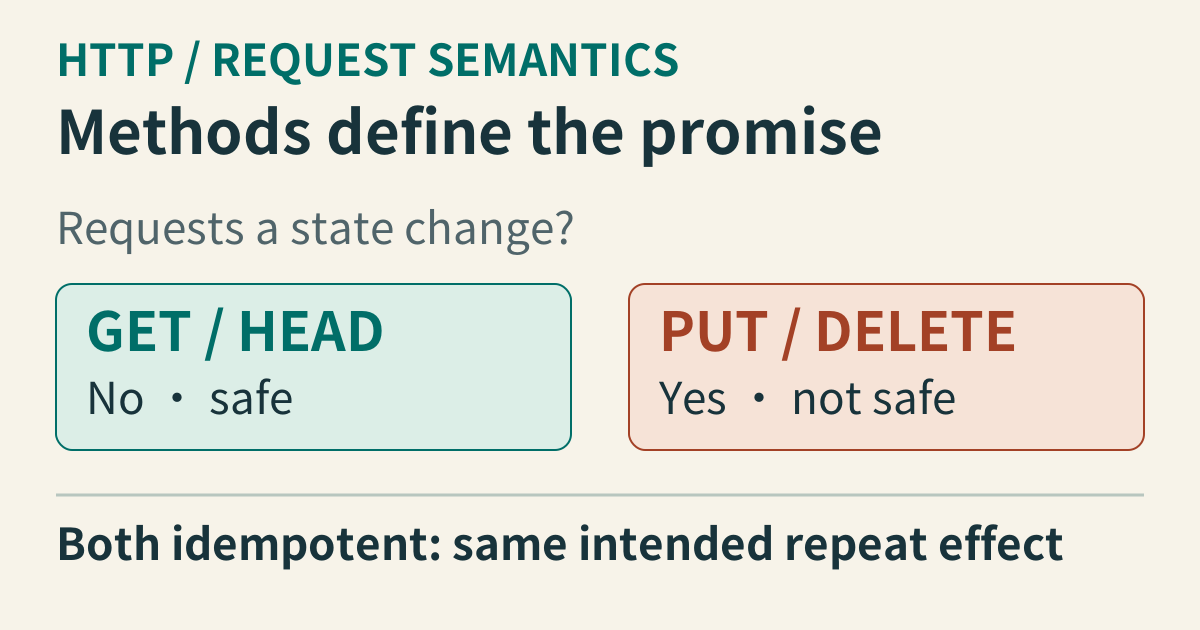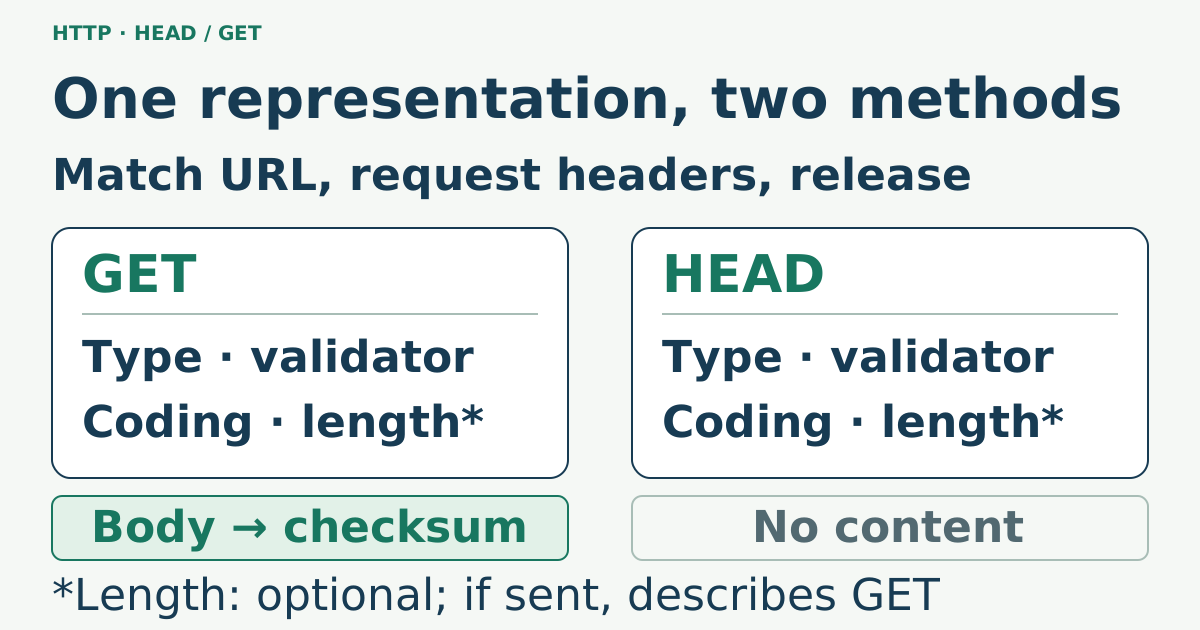
The HEAD method asks for the response a server would send to GET, without transferring the response content. It is useful for checks that need status, validators, type, or length, but only when the metadata remains aligned with the real GET path.
Compare a normalized header set
Dynamic headers such as Date will differ between requests. Compare the fields that describe the selected representation:
url=https://www.example.test/downloads/manual.pdf

curl -sS -I "$url" > head.headers
curl -sS -D get.headers -o /dev/null "$url"

for file in head.headers get.headers; do
  printf '== %s\n' "$file"
  awk '
    /^HTTP\// ||
    tolower($1) ~ /^(content-type:|content-length:|content-encoding:|cache-control:|etag:|last-modified:|vary:)$/ { print }
  ' "$file"
done
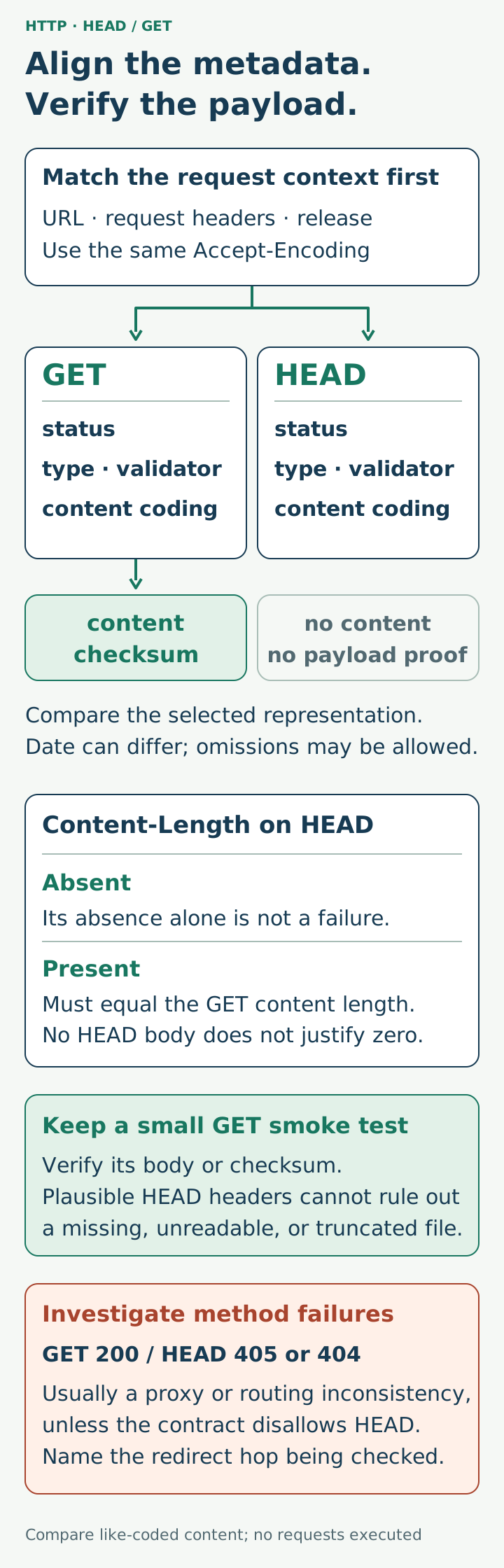
Run this in a disposable working directory; the two header files are overwritten. Match the URL, request headers, and release version. Compression negotiation belongs in the comparison: send the same Accept-Encoding value to both requests.
HEAD should describe the corresponding GET, but RFC 9110 permits omission of fields determined only while generating content. Missing Content-Length alone is not a failure. If present on HEAD, it must be the length the corresponding GET content would have, not zero just because HEAD has no body. Compare encoded lengths consistently and investigate changed validators or types rather than requiring byte-identical header lists.
Do not use HEAD as the only release check
A server can synthesize plausible headers while the file is missing, unreadable, or truncated. Keep one small GET in the smoke test and verify its body or checksum. HEAD reduces transfer cost; it does not prove the payload.
Check redirects explicitly
Without --location, curl -I reports the first response. That is useful when testing redirect policy. With --location, it prints header blocks for the followed responses, including intermediate redirects and the final destination. Record which question the command answers:
curl -sS -I --max-redirs 0 https://old.example.test/manual
curl -sS -I --location https://old.example.test/manual
Treat method-specific failures as configuration defects
A static page that returns 200 to GET and 405 or 404 to HEAD usually exposes a proxy or routing inconsistency. Fix the method handling instead of teaching monitors to ignore it, unless the endpoint contract deliberately disallows HEAD.
Sources
- RFC 9110 — HTTP Semantics, HEAD method semantics, checked 2026-10-15.
- curl manual,
--head,--include, and redirect options, checked 2026-10-15.