A change that races to zero traffic but lands when nobody is watching trades one risk for another. The best window is one where the operators responsible can actually attend.
Traffic is only part of the math
Deploying at the absolute quietest hour minimizes how many users feel the change, but it collides with the people problem: the operator is most likely asleep, unreachable, or already covering another incident. If the rollout breaks at 3 a.m. and nobody is watching, a silent failure can run for hours before a human reads it. Least-traffic is a good starting estimate, but it is a traffic answer, not a risk answer. Balance reduced exposure against the ability to react, and prefer a window where you can actually observe the result.
Watch the human clock
The window has to fit the humans, not just the chart. Consider who must notice a broken deploy: the SRE on call, the feature owner, the support team, and schedule their attention into the slot. Also watch what else is scheduled — a parallel release, a job run, an adjacent change — that could tangle with yours and turn a clean rollout into a confusing blame-fest. A slot where the people who must read the result are awake, reachable, and not already overloaded beats a quieter one where nobody is watching.
Let the window be a habit
A recurring staffed window can help coordinate risky changes and make observation predictable. It is not a universal requirement to batch every release: small, automated, independently reversible changes may use a continuous-delivery workflow. Choose the cadence from actual risk and response coverage. Automate builds, smoke tests, and canaries, while preserving an accountable owner and a tested recovery path. A calendar slot should support those safeguards, not replace them.
When it breaks
An urgent fix arrives outside the window and there is no emergency lane. The team either waits while the incident burns, or someone pushes straight to production with no watcher and no rollback note. Without a documented break-glass path — who approves, who watches, what gets written down — every exception becomes a secret deploy. Rehearse an explicit emergency procedure alongside the normal schedule.
A second failure is the stampede inside the window. Four services land in the same two hours, their signals blend together, and when the error rate climbs nobody can name the culprit. Rollback becomes a negotiation instead of a button press. Serialize changes that share failure signals or dependencies, and require every entry to name its owner, signal, and way back.
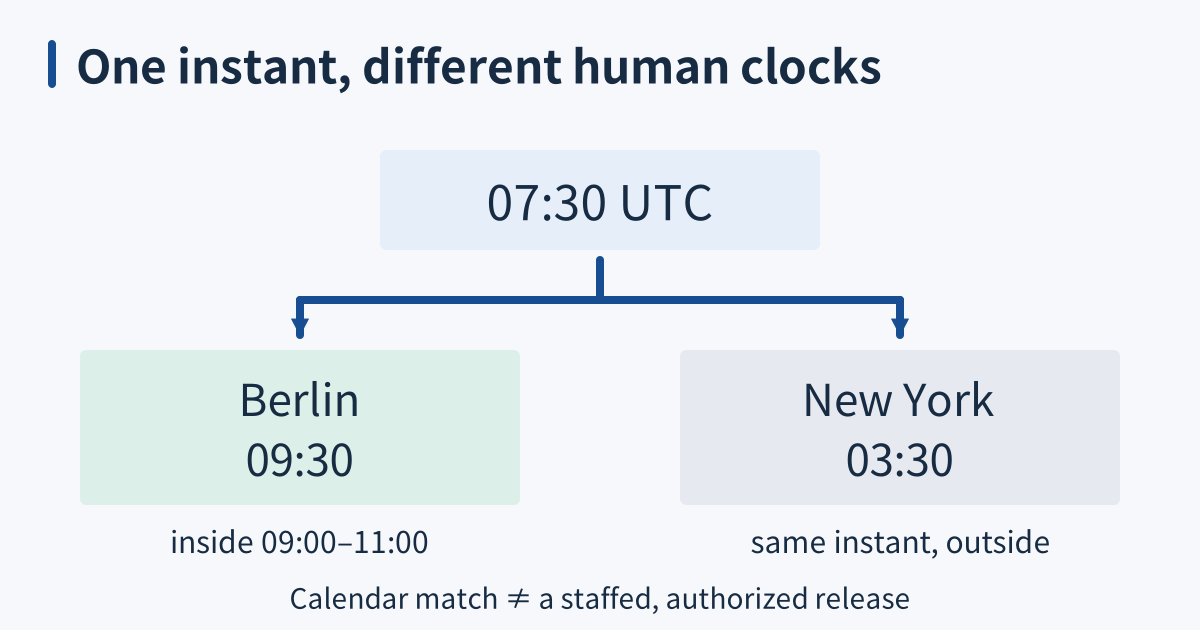
A third failure is the cross-timezone misread. The window says Wednesday 10:00 in Berlin, but a teammate in Los Angeles reads it as local time and ships while responders sleep. Daylight saving quietly shifts the slot by another hour. Store every window with its zone, render it locally, and confirm a human is present before counting a slot as staffed.
Check it quickly
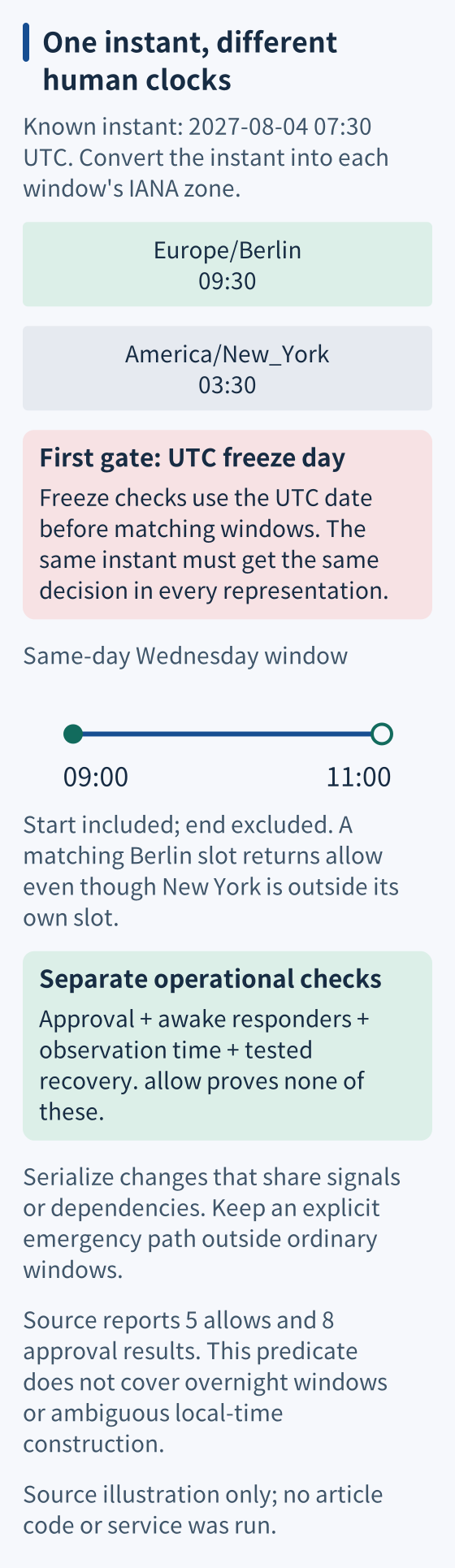
Use Python 3.9 or newer with IANA time-zone data available to zoneinfo; the module does not bundle that data. Save the following as change_window_check.py and run python3 change_window_check.py. Run without -O, -OO, or a nonzero PYTHONOPTIMIZE setting so the assertions execute. It uses only the standard library, treats every window as timezone-aware, and decides between allow and needs-approval. The table holds same-day Wednesday slots in Berlin and New York. Freeze dates use an explicitly chosen UTC policy day, regardless of the timezone used to express the input instant. The bad samples are negative controls.
from datetime import datetime, time
from zoneinfo import ZoneInfo

WINDOWS = [
    {"name": "berlin-wed", "weekday": 2, "start": "09:00", "end": "11:00", "tz": "Europe/Berlin"},
    {"name": "newyork-wed", "weekday": 2, "start": "09:00", "end": "11:00", "tz": "America/New_York"},
]
FREEZE_DATES = frozenset({"2027-12-24"})
FREEZE_ZONE = ZoneInfo("UTC")  # Organization-wide policy, independent of input representation.


def _hhmm(value):
    hour, minute = map(int, value.split(":"))
    return time(hour, minute)


def decide(moment, windows=WINDOWS, freeze=FREEZE_DATES):
    if moment.tzinfo is None or moment.utcoffset() is None:
        return "needs-approval", "naive datetime carries no zone; attach a ZoneInfo first"
    freeze_day = moment.astimezone(FREEZE_ZONE).date()
    if freeze_day.isoformat() in freeze:
        return "needs-approval", f"freeze date {freeze_day} in UTC; emergency path only"
    for window in windows:
        local = moment.astimezone(ZoneInfo(window["tz"]))
        if local.weekday() == window["weekday"] and _hhmm(window["start"]) <= local.time() < _hhmm(window["end"]):
            return "allow", f"inside {window['name']} ({local:%Y-%m-%d %H:%M %Z})"
    return "needs-approval", f"outside all windows ({moment:%Y-%m-%d %H:%M %Z})"


def check(actual, expected, label):
    status, reason = actual
    assert status == expected, f"{label}: got {status} ({reason})"
    print(f"{label}: {status} -- {reason}")


def main():
    berlin = ZoneInfo("Europe/Berlin")
    newyork = ZoneInfo("America/New_York")
    good_berlin = datetime(2027, 8, 4, 9, 30, tzinfo=berlin)
    good_ny = datetime(2027, 8, 4, 9, 30, tzinfo=newyork)
    check(decide(good_berlin), "allow", "good/berlin-wed-morning")
    check(decide(good_ny), "allow", "good/newyork-wed-morning")
    # Same UTC instant, different local reading: 07:30 UTC is 09:30 in Berlin but 03:30 in New York.
    same_instant = datetime(2027, 8, 4, 7, 30, tzinfo=ZoneInfo("UTC"))
    check(decide(same_instant), "allow", "good/same-instant-via-berlin")
    evening = datetime(2027, 8, 4, 22, 10, tzinfo=berlin)
    check(decide(evening), "needs-approval", "bad/wednesday-night")
    wrong_day = datetime(2027, 8, 5, 9, 30, tzinfo=berlin)
    check(decide(wrong_day), "needs-approval", "bad/thursday-morning")
    frozen = datetime(2027, 12, 24, 9, 30, tzinfo=berlin)
    check(decide(frozen), "needs-approval", "bad/freeze-date")
    naive = datetime(2027, 8, 4, 9, 30)
    check(decide(naive), "needs-approval", "bad/naive-datetime")
    misread = datetime(2027, 8, 4, 9, 30, tzinfo=ZoneInfo("America/Los_Angeles"))
    check(decide(misread), "needs-approval", "bad/timezone-misread")
    check(decide(datetime(2027, 8, 4, 9, 0, tzinfo=berlin)), "allow", "good/start-inclusive")
    check(decide(datetime(2027, 8, 4, 11, 0, tzinfo=berlin)), "needs-approval", "bad/end-exclusive")
    winter = datetime(2027, 1, 6, 8, 30, tzinfo=ZoneInfo("UTC"))
    check(decide(winter), "allow", "good/winter-berlin")
    # This Wednesday would otherwise pass: the freeze test cannot pass by accident.
    frozen_wednesday = frozenset({"2027-08-04"})
    shifted = same_instant.astimezone(ZoneInfo("Etc/GMT+12"))
    assert shifted == same_instant and shifted.date() != same_instant.date()
    check(decide(same_instant, freeze=frozen_wednesday), "needs-approval", "bad/UTC-freeze")
    check(decide(shifted, freeze=frozen_wednesday), "needs-approval", "bad/same-freeze-other-zone")
    assert decide(same_instant, freeze=frozen_wednesday) == decide(shifted, freeze=frozen_wednesday)
    print("PASS: 5 allows and 8 approvals; policy dates do not depend on caller timezone")


if __name__ == "__main__":
    main()
The script prints five allow results and eight needs-approval results. Window starts are inclusive and ends exclusive. The summer and winter UTC cases reach Berlin at 09:30 despite different offsets. A Wednesday freeze rejects an otherwise eligible instant both in UTC and in a representation whose local date is the previous day. Checking the input date directly would incorrectly allow that second representation.
These revised assertions passed with Python 3.12.14. Allow means only that this schedule predicate passed; it grants no deployment authorization and verifies no staffing. This same-day fixture does not handle overnight windows or validate ambiguous local-time construction. Convert a known instant, then separately check approvals, the on-call roster, observation time, and recovery readiness.
Further reading
Sources
- Google SRE: release engineering, release as an engineered practice, checked 2026-10-15.
- 12Factor: build release run, separating build from release, checked 2026-10-15.
- Python datetime, aware timestamps and conversion between timezone representations, checked 2026-10-15.
- Python zoneinfo, IANA timezone rules and daylight-saving transitions, checked 2026-10-15.