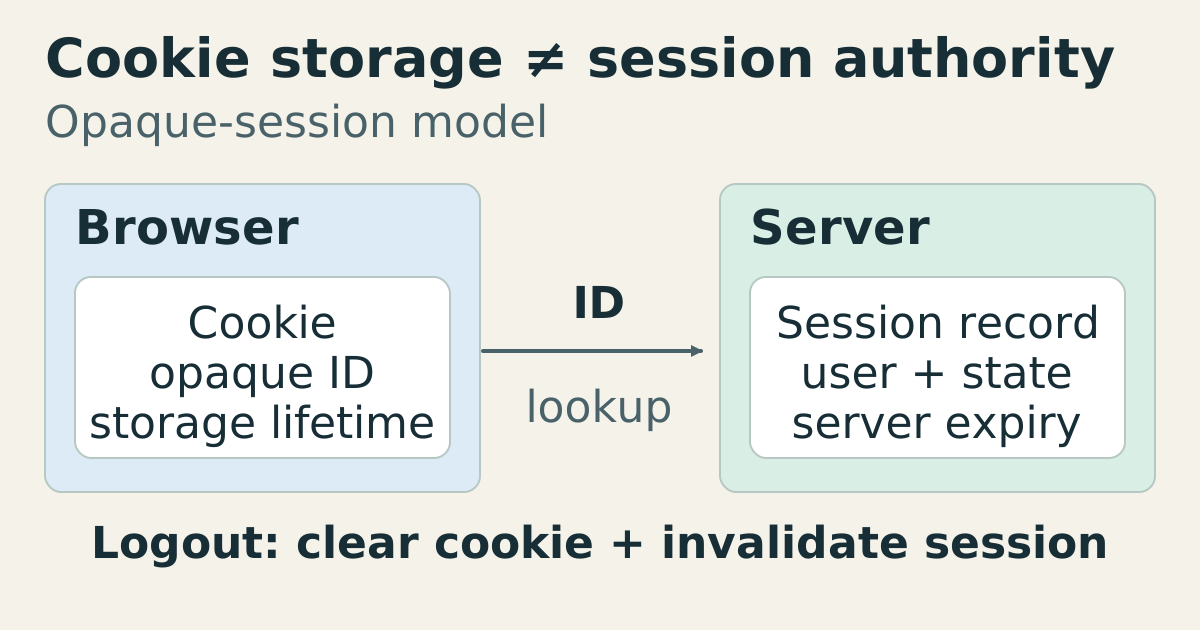
A cookie is a browser storage and transport mechanism. A server-side session is one application design that uses a cookie value to locate stored state. Keeping those responsibilities separate makes login, expiry, and logout testable. This article follows an opaque session identifier, rather than repeating the host, path, or SameSite matching rules.
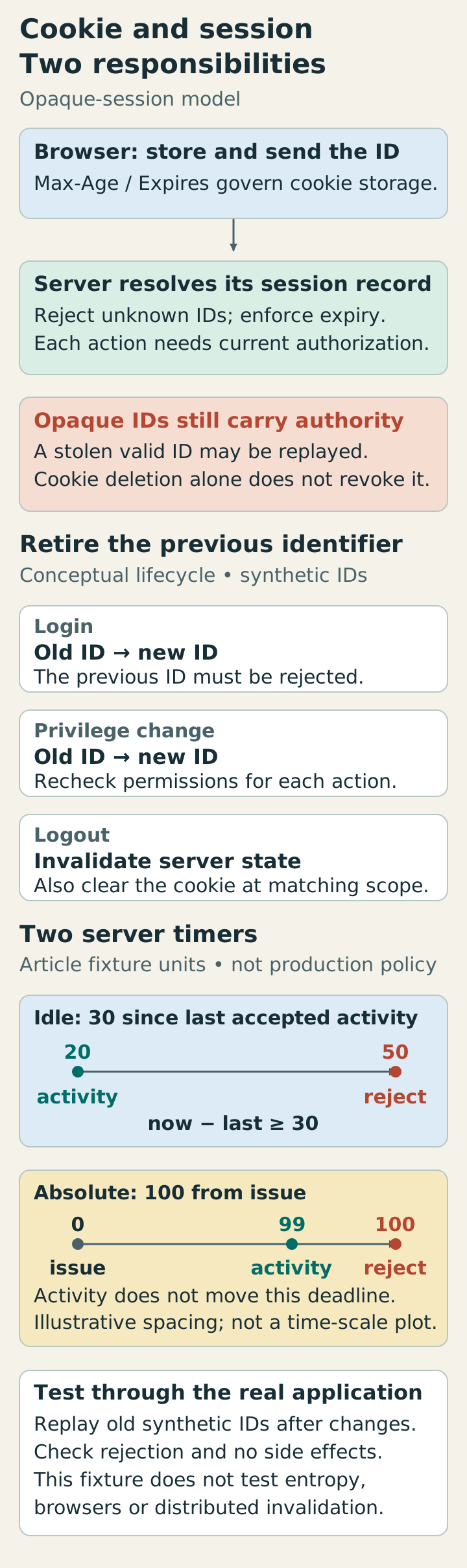
A bearer identifier still carries authority
In this design, the server generates an unpredictable identifier and associates it with a session record. The value is opaque to the client, but possession can still authorize access: anyone who steals a valid bearer identifier may replay it. Calling it “only a pointer” must not suggest that it is harmless. Avoid putting it in URLs, logs, or diagnostic screenshots.
Plain client-controlled roles must not be trusted. However, meaningful data in a cookie is not automatically forgeable: correctly authenticated, signed session formats are another design. Signing protects integrity, not confidentiality, and stateless designs still need explicit expiry, key management, and revocation decisions. Choose a maintained session framework instead of inventing a format merely to avoid a server lookup.
For an opaque scheme, generate tokens with a cryptographically secure random generator and adequate entropy. Reject unknown identifiers rather than creating privileged state under an arbitrary client-supplied value. Resolve the session on the server and authorize each operation against current permissions. An authenticated session does not automatically grant access to every object or every administrative action.
Two lifetimes need two controls
Cookie Max-Age and Expires govern client storage; they do not expire the server’s session record. A non-browser client can retain and replay the value after the browser would delete it. Likewise, a browser-session cookie can survive through session-restore behavior. Enforce absolute and idle expiry on the server, with explicit boundary comparisons and a consistent time source.
Logout must invalidate server-side state as well as clear the browser cookie at the matching scope. Otherwise a copied token remains useful. Rotating the identifier after authentication and privilege changes helps prevent fixation, but only if the previous identifier loses its authority. Concurrent requests and distributed stores require careful coordination so an old request cannot silently recreate a revoked session.
Secure and HttpOnly protect transport and script access respectively; HttpOnly does not prevent injected script from making authenticated requests. SameSite is a browser-context defense, not server expiry or permission checking. Cookie and header limits also vary across browsers and servers: there is no universal eight-kilobyte request-header limit. Keeping the token compact avoids unnecessary overhead without pretending size alone determines security.
When it breaks
A login upgrades a pre-authentication record while keeping an identifier that an attacker already knows. A logout deletes only the cookie, leaving a copied value valid. An idle timeout is checked only by JavaScript, allowing a direct client to continue. These failures all occur on the server lifecycle even if every cookie attribute looks correct in developer tools.
Do not assume periodic activity should extend access forever. An idle timer can slide with accepted activity while an absolute deadline remains fixed for that session. Decide whether reauthentication or privilege elevation begins a new lifetime. State the policy explicitly so a token refresh does not accidentally reset an intended hard limit indefinitely.
Check it quickly
Save this as session-lifecycle.py and run python3 session-lifecycle.py with Python 3.11 or newer. It uses synthetic users, predictable fixture identifiers, and an injected clock. It opens no sockets and provides no authentication service. Never use the identifier generator or this in-memory model for a real application.
from itertools import count

# Predictable identifiers are deliberate fixtures, never production tokens.
identifiers = count(1)
sessions = {}
IDLE = 30
ABSOLUTE = 100


def issue(user, role, now):
    sid = f"fixture-{next(identifiers)}"
    sessions[sid] = {"user": user, "role": role, "born": now, "last": now}
    return sid


def lookup(sid, now):
    session = sessions.get(sid)
    if session is None:
        return None
    if now - session["born"] >= ABSOLUTE or now - session["last"] >= IDLE:
        sessions.pop(sid)
        return None
    session["last"] = now
    return session.copy()


def rotate(sid, user, role, now):
    assert lookup(sid, now) is not None
    sessions.pop(sid)
    return issue(user, role, now)


def logout(sid):
    sessions.pop(sid, None)


assert lookup("attacker-chosen", 0) is None
anonymous = issue(None, "anonymous", 0)
authenticated = rotate(anonymous, "demo-user", "reader", 1)
assert authenticated != anonymous and lookup(anonymous, 1) is None
privileged = rotate(authenticated, "demo-user", "editor", 2)
assert lookup(authenticated, 2) is None
assert lookup(privileged, 2)["role"] == "editor"
logout(privileged)
assert lookup(privileged, 3) is None
print("PASS: unknown ID, login rotation, privilege rotation, and logout")

idle = issue("demo-user", "reader", 0)
assert lookup(idle, 20) is not None
assert lookup(idle, 50) is None
active = issue("demo-user", "reader", 0)
for now in (20, 40, 60, 80, 99):
    assert lookup(active, now) is not None
assert lookup(active, 100) is None
assert not sessions
print("PASS: idle and absolute expiry reject at the configured boundary")
The first line confirms rejection of an unknown identifier, replacement after login and elevation, rejection of the replaced identifiers, and logout invalidation. Rotation deliberately begins a new fixture lifetime; the policy is visible in issue. The second line checks expiry exactly at thirty idle units and one hundred absolute units, even with activity just before the absolute deadline.
The assertions test lifecycle logic, not entropy, browser behavior, persistent storage, concurrent rotation, or distributed revocation. Production verification should replay an old synthetic session after login, elevation, logout, and timeout through the actual application. Verify both rejection and the absence of side effects. A successful cookie-deletion response alone does not establish that the old credential stopped working.
Further reading
Sources
- OWASP Session Management, unpredictable identifiers, regeneration, expiry and invalidation, checked 2026-10-15.
- RFC 6265: cookie lifetime, cookie storage lifetime and attributes, checked 2026-10-15.
- RFC 7519: JWT, signed-token security considerations and trust decisions, checked 2026-10-15.