Gossip spreads information through repeated peer contact. It can tolerate some lost exchanges because surviving copies can be sent again. Eventual convergence still needs assumptions: relevant peers must become reachable, updates must remain available, and the merge rule must handle the states that can arise. Random contact alone does not guarantee agreement by a fixed deadline.
Separate dissemination from reconciliation
A node can periodically push state, pull another node’s state, or exchange in both directions. These are protocol choices, not a requirement that every gossip message be symmetrical. A bounded number of contacts per node can spread a small update rapidly through a well-connected population. Logarithmic dissemination estimates describe particular probabilistic models; they are not a worst-case timer derived from one network round trip.
Membership gossip also does not make application writes consistent by itself. Dynamo uses gossip for membership, vector clocks for object versions, and Merkle-tree anti-entropy for repairing replicas. Those mechanisms solve different problems. A membership protocol’s incarnation number distinguishes states of one member; it is not automatically a causal version for arbitrary business data.
The model below intentionally assumes one writer per key and increasing versions. Selecting the larger version is enough for its single update. Equal versions containing different values expose an undefined conflict policy: retaining whichever value arrived first makes the merge order-dependent. Production reconciliation needs a declared policy for concurrency, duplicate delivery, deletion, and restart identity.
When it breaks
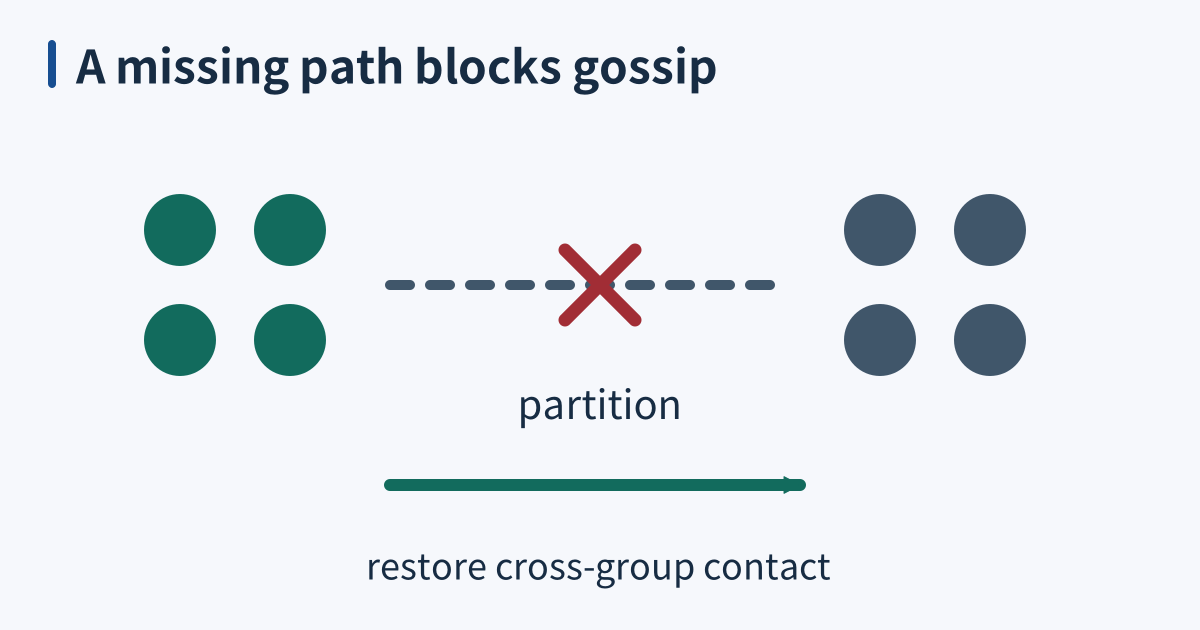
A lasting partition prevents an update from crossing between disconnected components. Repetition inside each component cannot repair that missing path. After connectivity returns, reconciliation can resume if the necessary state still exists. A deleted item also needs a deletion representation and retention policy; expiring tombstones too early can let stale data return. Version vectors and tombstones are complementary mechanisms, not interchangeable guarantees against lost writes.
A slow or paused member can resemble a failed one. SWIM separates failure detection from infection-style dissemination and adds suspicion so a member can refute a suspected failure with a newer incarnation. This reduces false declarations under its assumptions; it does not provide a perfect failure detector during arbitrary delays. Re-replication and ownership changes are decisions of the surrounding system, not inevitable consequences of every gossip suspicion.
Repair consumes resources too. Full-state exchanges, aggressive intervals, and simultaneous rejoins can overload links or receivers. Bounded fanout, incremental exchange, and controlled recovery help, but costs depend on state size as well as the number of contacted peers. Restart versioning must follow the implementation’s identity rules: resetting a counter can make new announcements appear stale or create ambiguity; a lower counter does not inherently overwrite a higher one.
Check it quickly
Save this as check_gossip.py and run python3 check_gossip.py. It uses only Python’s standard library and no sockets. Twenty dictionaries model peers; each sweep visits nodes sequentially and performs push-pull merges. A fixed seed reproduces the random choices in this runtime. Knowledge can cross several contacts during one sweep, so this is not a synchronized network-round simulator.
import random

NODES, ROUNDS, SEED = 20, 12, 7

def merge(a, b):
    # One writer per key, with strictly increasing versions in this fixture.
    merged = dict(a)
    for key, (version, value) in b.items():
        if key not in merged or version > merged[key][0]:
            merged[key] = (version, value)
    return merged

def spread(peer_for, nodes=None):
    rng = random.Random(SEED)
    if nodes is None:
        nodes = [{} for _ in range(NODES)]
        nodes[0]["config"] = (1, "blue")
    history = []
    for _ in range(ROUNDS):
        # Sequential contacts: knowledge can travel several hops in one sweep.
        for i in range(NODES):
            peer = peer_for(i, rng)
            if peer == i:
                continue
            united = merge(nodes[i], nodes[peer])
            nodes[i], nodes[peer] = dict(united), dict(united)
        history.append(sum(state.get("config") == (1, "blue") for state in nodes))
    return nodes, history

random_peer = lambda i, rng: rng.randrange(NODES)
nodes, history = spread(random_peer)
assert history[-1] == NODES
assert all(a <= b for a, b in zip(history, history[1:]))
print("random contacts:", history)

# A fixed hub is connected; fixed contacts do not inherently prevent convergence.
_, hub = spread(lambda i, rng: 0)
assert hub[0] == NODES
print("fixed hub after one sweep:", hub[0])

# Two disconnected peer sets retain different views until contacts can cross.
partitioned, split = spread(lambda i, rng: (i // 10) * 10 + rng.randrange(10))
assert split[-1] == 10 and all(not node for node in partitioned[10:])
_, healed = spread(random_peer, partitioned)
assert healed[-1] == NODES
print("partition:", split[-1], "after healing:", healed[-1])

# Dissemination alone cannot repair an ambiguous concurrent-write merge rule.
a, b = {"config": (2, "red")}, {"config": (2, "green")}
assert merge(a, b) != merge(b, a)
print("equal-version conflict is order-dependent: not a multi-writer merge")
print("PASS: dissemination, topology, partition, and merge controls")
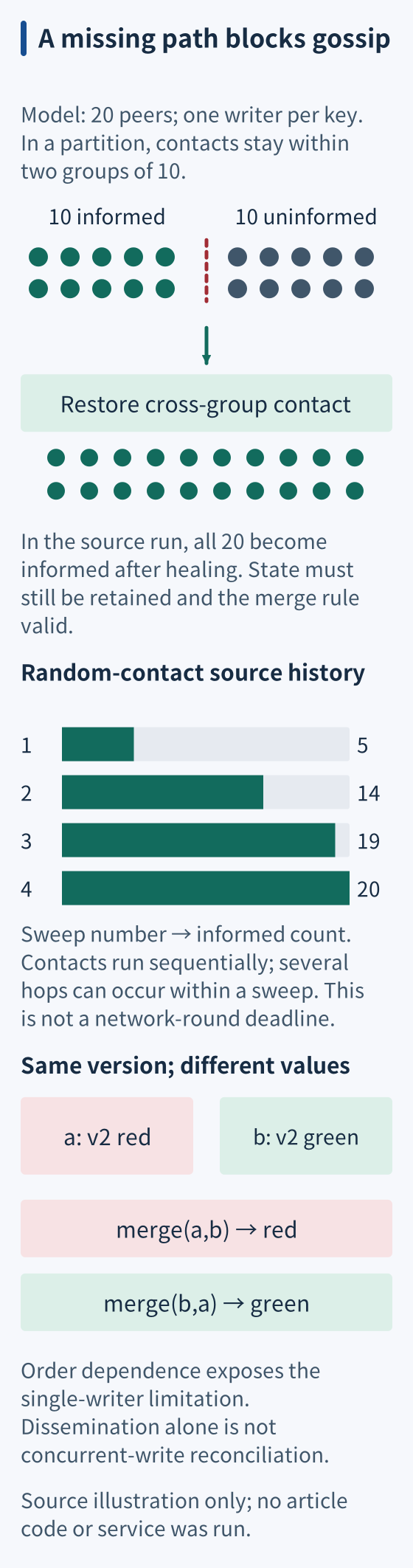
The random-contact history is 5, 14, 19, then 20 informed peers, with later sweeps staying at 20. That reproduces the original single-update observation, which was recorded with CPython 3.12 on macOS. It is evidence about this input and schedule, not a probability bound for other seeds or deployed clusters. The current model adds explicit counterexamples rather than inferring reliability from that successful run alone.
Every node contacting the same live hub spreads the update to all twenty in one sweep. Fixed partners therefore do not necessarily stall dissemination; connectivity and scheduling matter. The partition control confines contact to two groups of ten, leaving the second group uninformed. Restoring unrestricted contacts eventually informs everyone in this deterministic run.
Finally, merging equal-version red and green values in opposite orders produces different results. That assertion demonstrates the fixture’s single-writer limitation instead of silently calling it general conflict resolution. No network loss, suspicion timeout, tombstone lifecycle, bandwidth budget, or real membership implementation is exercised. Measure those separately before choosing operational convergence targets.
Further reading
Sources
- Dynamo: Amazon’s highly available key-value store, gossip-based membership and anti-entropy with version reconciliation, checked 2026-09-12.
- SWIM: Scalable Weakly-consistent Infection-style process group Membership protocol, suspicion mechanism and incarnation numbers for failure detection, checked 2026-09-12.
- Cassandra internode communications (gossip), peer-to-peer state exchange with versioned gossip messages, checked 2026-09-12.