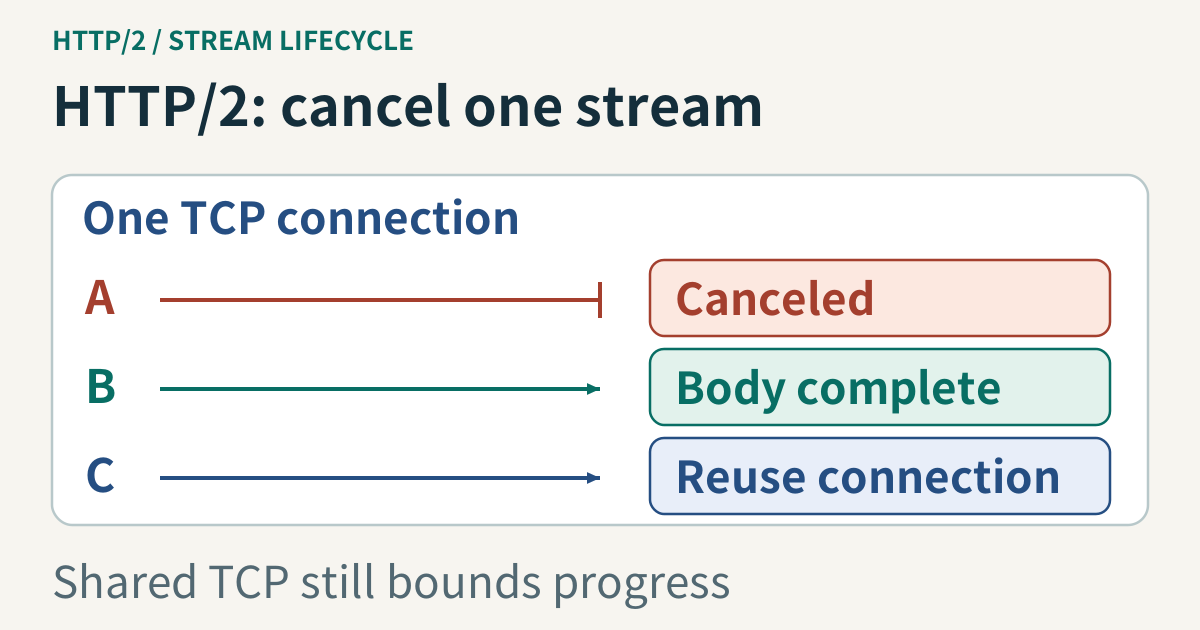
gRPC’s HTTP/2 transport lets multiple RPC attempts share a connection while keeping each stream’s messages ordered. That is useful for both short calls and long-lived exchanges. It does not make the connection an unlimited independent transport for every call: bandwidth, TCP delivery, connection flow control, and implementation resources remain shared.
Match the RPC shape to the work
An HTTP/2 RPC attempt occupies a stream; a retry starts another attempt rather than replaying bytes into a completed stream. Reusing connections amortizes establishment and TLS costs, but a channel can manage multiple connections. Calls to different backends do not all magically share one TCP endpoint, and per-call costs still include serialization, metadata, framing, scheduling, and application work.
gRPC offers unary, client-streaming, server-streaming, and bidirectional-streaming methods. Only the last permits independent sequences of messages in both directions within the same RPC. Message ordering is preserved within each direction, without requiring one response per request message. Choose that shape when the application needs it, rather than assuming every gRPC method streams both ways.
HTTP/1.1 can reuse persistent connections, and WebSocket already supports bidirectional messages. Neither inherently needs a fresh handshake for every application message. gRPC’s advantages instead include its RPC contract, generated interfaces, status model, and HTTP/2 stream multiplexing. Compare complete workloads and operational constraints before claiming that streaming is universally faster or requires less buffering.
Separate call deadlines from shared transport
A deadline belongs to an RPC, not automatically to every stream on its connection. Propagate the remaining budget into downstream calls using the language’s supported context mechanism. Starting a fresh full timeout at each hop can extend work beyond the caller’s willingness to wait. Cancellation also needs cooperation from application work; it does not undo effects already committed.
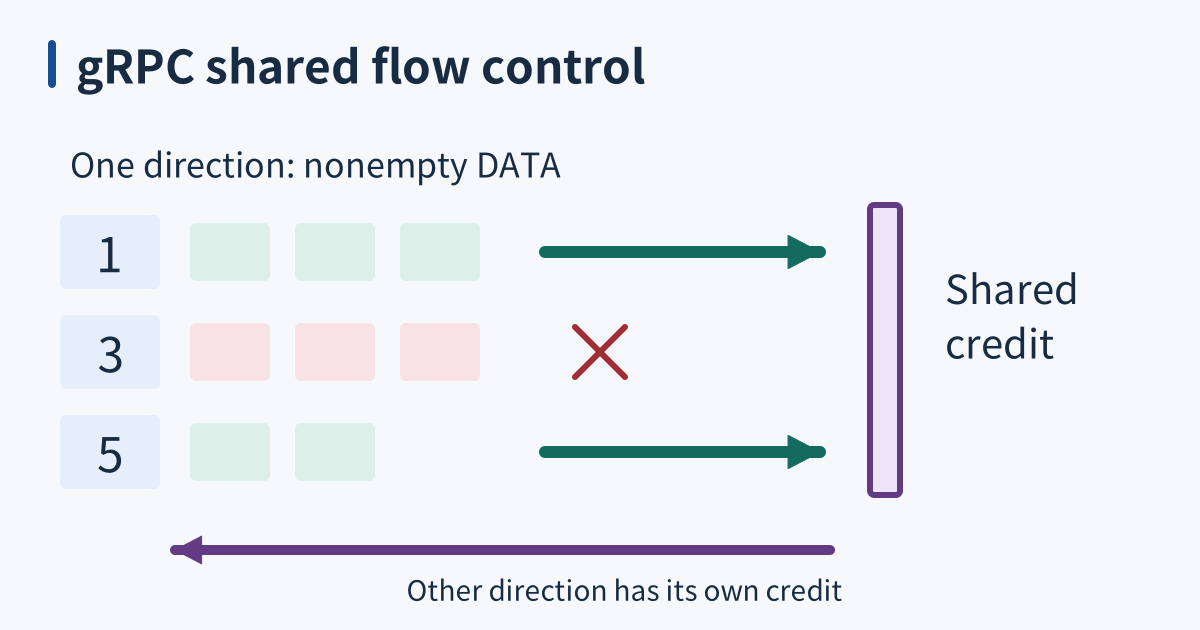
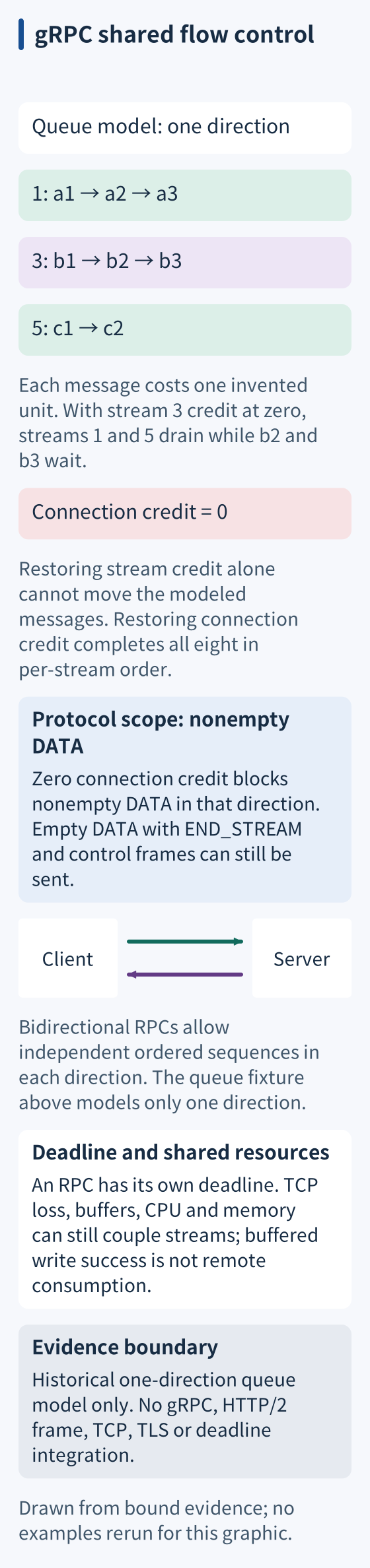
Flow control has both stream and connection scopes for DATA frames. An exhausted stream window can stop that stream while siblings progress if connection credit remains available. Exhausted connection credit prevents nonempty DATA across streams in that direction; zero-length DATA with END_STREAM and control frames can still be sent. Receiver implementations can replenish connection credit independently, so one slow reader does not inevitably exhaust the entire connection.
TCP packet loss can still delay delivery shared by multiple HTTP/2 streams. Queues, CPU, and memory also create coupling outside the protocol’s stream abstraction. A successful write into a library buffer does not establish remote delivery or application consumption. Bound buffers and test slow-reader behavior in the actual client and server libraries.
When it breaks
Oversized metadata can exceed an implementation or proxy limit before the handler runs. The gRPC guide suggests an eight-kibibyte default request-header limit, not a universal maximum or one guaranteed failure status. Inspect both endpoints and intermediaries, and avoid assuming that resending unchanged metadata will fix rejection.
A long-lived stream remains on its selected backend. Connection-level load balancing can concentrate many streams, and reaching concurrent-stream limits may queue new calls rather than create another connection. Choose supported client or proxy balancing deliberately; changing connection lifetime or stream limits is not proof of redistribution. Observe backend occupancy and reconnect behavior before tuning.
Check it quickly
Save this as mux_sim.py and run python3 mux_sim.py. The standard-library model uses three ordered queues with separate stream and connection credits. Each message costs one invented unit; these are not encoded HTTP/2 frames or actual byte windows. Use assertions enabled, without -O or PYTHONOPTIMIZE: pump calls inside assert are part of the scenario. Odd stream identifiers resemble the client side without implementing the wire protocol.
from collections import deque

original = {1: ["a1", "a2", "a3"], 3: ["b1", "b2", "b3"], 5: ["c1", "c2"]}
streams = {sid: deque(items) for sid, items in original.items()}
credit = {1: 3, 3: 3, 5: 2}
connection_credit = 8
wire = []
delivered = {sid: [] for sid in streams}

def pump():
    global connection_credit
    progressed = False
    for sid in sorted(streams):
        if streams[sid] and credit[sid] > 0 and connection_credit > 0:
            payload = streams[sid].popleft()
            credit[sid] -= 1
            connection_credit -= 1
            wire.append((sid, payload))
            delivered[sid].append(payload)
            progressed = True
    return progressed

def drain():
    while pump():
        pass

assert pump()
assert wire == [(1, "a1"), (3, "b1"), (5, "c1")]
credit[3] = 0  # Model a receiver withholding this stream's credit.
drain()
assert delivered[1] == original[1] and delivered[5] == original[5]
assert delivered[3] == ["b1"] and len(wire) == 6
assert connection_credit == 2

credit[3] = 2
connection_credit = 0  # Independent negative control: no connection capacity.
assert not pump() and delivered[3] == ["b1"]
connection_credit = 2
drain()
assert delivered == original and len(wire) == 8
assert connection_credit == 0 and all(not queue for queue in streams.values())
print("wire:", wire)
print("PASS: stream credit isolates one stall; connection credit gates all modeled data")
After one pass, withholding stream 3’s credit lets streams 1 and 5 complete while stream 3 retains two queued messages. Restoring only its stream credit is insufficient when the connection control is set to zero: no message advances. Restoring connection credit then drains all eight messages, with each stream retaining its original order.
Retained exact runs establish these model rules with assertions enabled; this source review did not rerun them. They do not test a gRPC library, HTTP/2 frame encoding, TCP loss, TLS, deadline propagation, cancellation, or balancing. Keep this small experiment separate from a real integration test that deliberately slows one consumer and records stream-level versus connection-level behavior.
Further reading
Sources
Python assert statement, optimization omits assertions and any calls inside them, checked 2026-10-18.
gRPC core concepts, defines streams over HTTP/2, checked 2026-06-01.
RFC 9113: HTTP/2, streams, multiplexing, and flow control, checked 2026-09-09.
gRPC flow control, buffering and slow-reader boundaries, checked 2026-10-15.
gRPC deadlines, per-RPC budgets and propagation, checked 2026-10-15.
gRPC metadata, suggested header limits, checked 2026-10-15.
gRPC performance guidance, channels, concurrent-stream queues, and long-lived streaming limits, checked 2026-10-15.