A materialized answer saves repeated computation by storing a query result. The decision is economic and semantic: how much work will reuse avoid, and which source state may readers accept? This article focuses on that budget. PostgreSQL’s native materialized-view lifecycle has additional prerequisites; a stored answer should never acquire a freshness promise merely because its reads are fast.
Compare the work you actually avoid
A normal view stores a query definition. Reading a materialized result can avoid rerunning its joins and aggregates, although the saved relation still needs its own access path. Refresh moves work elsewhere rather than eliminating it. Include computation, temporary space, index maintenance, scheduling, and unsuccessful refresh attempts when estimating the cost of repeated reuse.
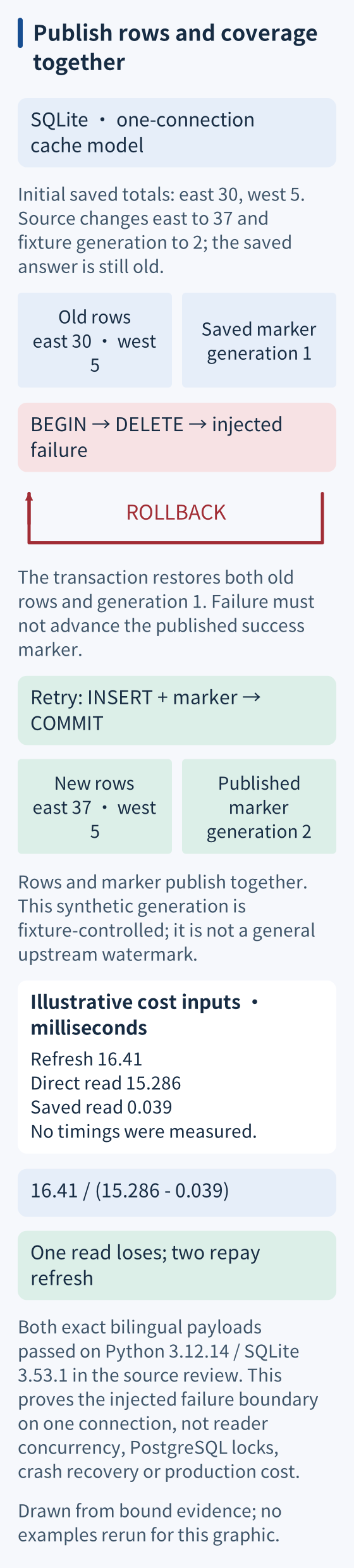
Break-even is refresh cost divided by the saving per read, not the ratio between direct and cached read latency. With illustrative costs of 16.41 milliseconds per refresh, 15.286 per direct read, and 0.039 per saved read, two reads repay one refresh. Those numbers are inputs to arithmetic here, not measured results. A different query, cache state, or refresh frequency changes the answer completely.
Choose an aggregation grain deliberately. Daily summaries may support repairing selected days, but late arrivals, corrections, deletes, and changes to grouping keys must identify every affected partition. PostgreSQL’s standard REFRESH MATERIALIZED VIEW still reruns the defining query; a manually maintained summary table needs its own correct incremental-maintenance protocol. Calling a table materialized does not supply that protocol.
Publish the answer and its evidence together
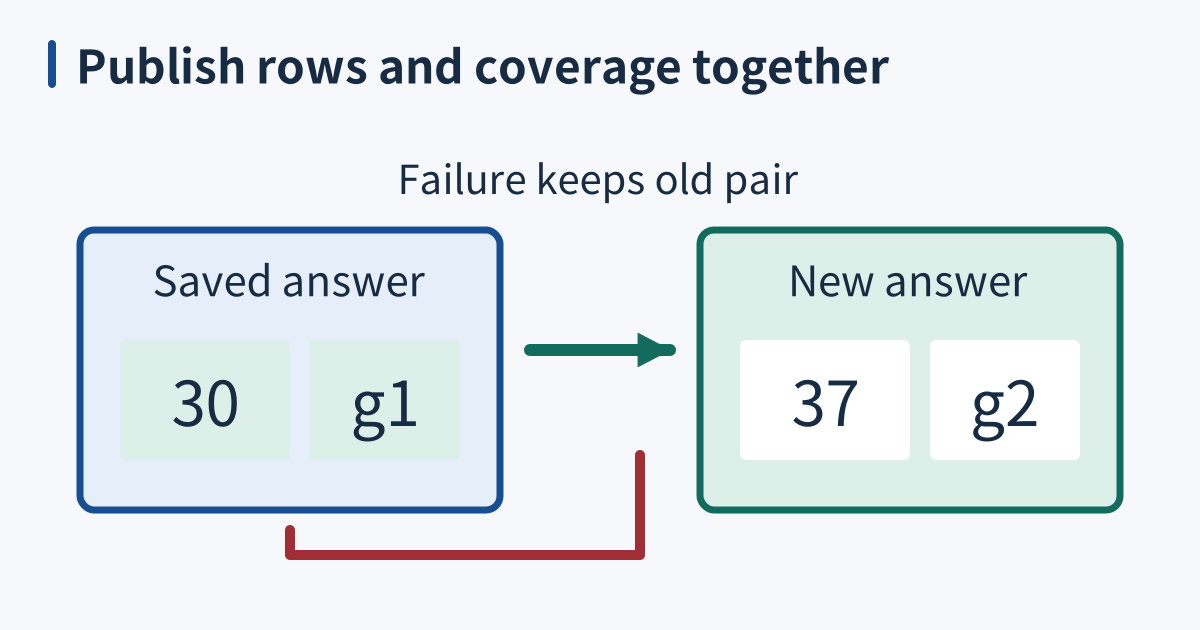
A successful refresh completion time is not necessarily the source time represented by the answer. A long-running query can read an earlier snapshot; upstream ingestion can itself lag. Record the source coverage or generation that matters to the report as well as job success. If a refresh fails, its success marker must not advance while old rows remain published.
A schedule does not enforce a maximum age. Delayed starts, lock waits, failed jobs, and lengthy computation all add uncertainty. Nor is numeric error bounded by write rate times elapsed time without assumptions about each change’s magnitude. One large correction can move a sum substantially. Decide whether stale reads remain useful, should carry an age indicator, or must be rejected.
When it breaks
Native PostgreSQL refresh without CONCURRENTLY acquires ACCESS EXCLUSIVE and can block readers. Concurrent refresh allows ordinary SELECT but still takes locks and requires a populated view plus an eligible all-row unique index using plain columns. EXCLUSIVE is not simply a writes-only lock: its conflicts include ROW SHARE as a general table-lock rule. Only one refresh can run on the same view at once.
SQLite transaction and WAL observations cannot establish those PostgreSQL lock rules. A fast staging-table swap is also not a universal replacement for native refresh: dependencies, privileges, object identity, and transaction boundaries need explicit handling. Keep each engine’s evidence attached to that engine, and test representative readers separately from checking the saved values.
Check it quickly
Save this as materialized_budget.py and run Python 3. This standard-library exercise uses an SQLite in-memory table as an explicitly maintained summary. SQLite does not provide PostgreSQL’s native materialized-view commands. Keep Python assertions enabled. The exact bilingual payload passed this review on Python 3.12.14 with SQLite 3.53.1. Its single connection checks stale results, transactional publication and a failed refresh, with no reader-concurrency or performance claim.
import sqlite3

# SQLite has no native materialized-view command: this is an explicit cache table.
db = sqlite3.connect(":memory:", isolation_level=None)
db.executescript("""
CREATE TABLE sales (region TEXT NOT NULL, amount INTEGER NOT NULL);
CREATE TABLE source_version (generation INTEGER NOT NULL);
INSERT INTO source_version VALUES (1);
INSERT INTO sales VALUES ('east',10),('east',20),('west',5);
CREATE VIEW live_totals AS SELECT region,sum(amount) total FROM sales GROUP BY region;
CREATE TABLE saved_totals (region TEXT PRIMARY KEY,total INTEGER NOT NULL);
CREATE TABLE refresh_state (generation INTEGER NOT NULL);
INSERT INTO refresh_state VALUES (0);
""")

def refresh(fail=False):
    db.execute("BEGIN")
    try:
        generation = db.execute("SELECT generation FROM source_version").fetchone()[0]
        db.execute("DELETE FROM saved_totals")
        if fail:
            raise RuntimeError("injected failure after deleting old rows")
        db.execute("INSERT INTO saved_totals SELECT * FROM live_totals")
        db.execute("UPDATE refresh_state SET generation=?", (generation,))
        db.execute("COMMIT")
    except Exception:
        db.execute("ROLLBACK")
        raise

def rows(relation):
    assert relation in {"saved_totals", "live_totals"}
    return db.execute("SELECT * FROM " + relation + " ORDER BY region").fetchall()

refresh()
assert rows("saved_totals") == [("east",30),("west",5)]
db.executescript("""BEGIN;
UPDATE sales SET amount=17 WHERE region='east' AND amount=10;
UPDATE source_version SET generation=2;
COMMIT;""")
assert rows("live_totals") == [("east",37),("west",5)]
assert rows("saved_totals") == [("east",30),("west",5)]
try:
    refresh(fail=True)
except RuntimeError:
    pass
else:
    raise AssertionError("injected refresh should fail")
assert rows("saved_totals") == [("east",30),("west",5)]
assert db.execute("SELECT generation FROM refresh_state").fetchone()[0] == 1
refresh()
assert rows("saved_totals") == rows("live_totals")
assert db.execute("SELECT generation FROM refresh_state").fetchone()[0] == 2
# Illustrative costs, not timings measured by this program.
refresh_ms, direct_ms, cached_ms = 16.41, 15.286, 0.039
assert refresh_ms + 2 * cached_ms < 2 * direct_ms
assert refresh_ms + cached_ms > direct_ms
print("old answer survived failed refresh; successful refresh published generation 2")
print("illustrative break-even: 2 reads, not the direct/cached speed ratio")
print("SQLite", sqlite3.sqlite_version)
db.close()
Initially east totals thirty and west five. Updating one source amount makes the live east total thirty-seven while the saved answer remains thirty. The synthetic source generation also advances. It is a fixture-controlled marker, not a general solution for tracking arbitrary upstream changes.
The injected failure occurs after deleting saved rows inside a transaction. Rollback preserves both the old answer and generation one. The successful retry publishes updated rows and generation two together. These assertions establish the chosen failure boundary without inventing throughput measurements or claiming a cross-database locking test.
In production, ensure the refresh role can perform its work, measure the actual query, and test what readers see during success and failure. Keep an independently meaningful freshness signal with the result. Reuse is valuable when the saved work exceeds the maintenance cost and the recorded source coverage satisfies the reader’s contract.
Sources
- PostgreSQL materialized views, stored results and indexing, checked 2026-10-15.
- PostgreSQL refresh, complete recomputation and concurrent prerequisites, checked 2026-10-15.
- PostgreSQL explicit locking, refresh lock modes and conflicts, checked 2026-10-15.
- SQLite transactions, explicit commit and rollback for the scoped fixture, checked 2026-10-15.