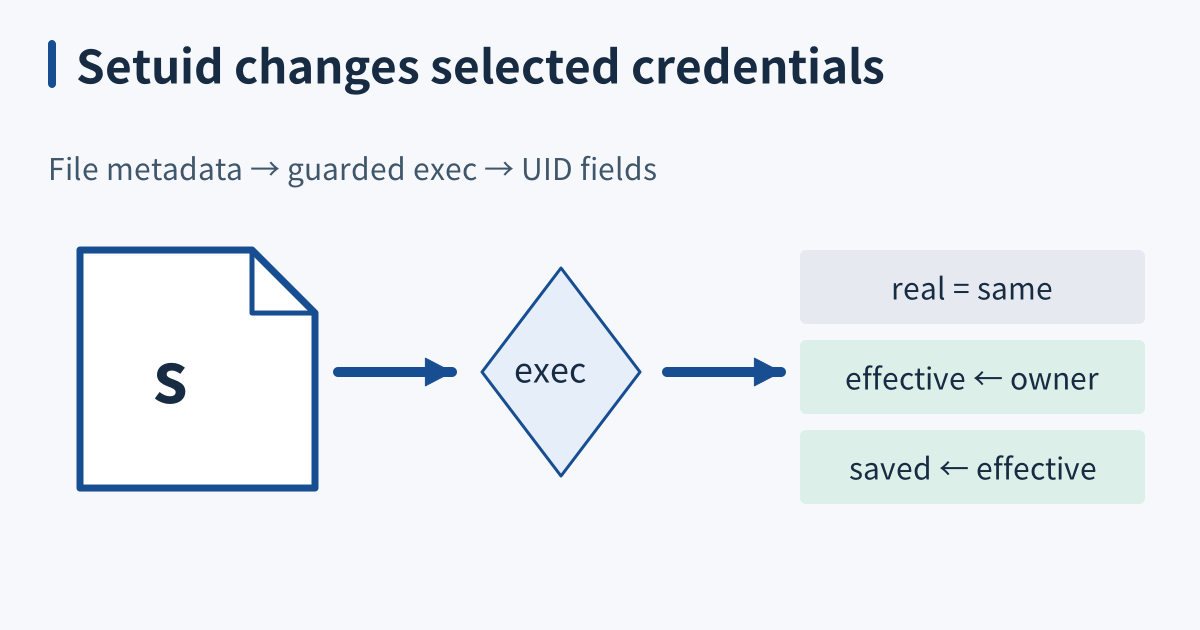
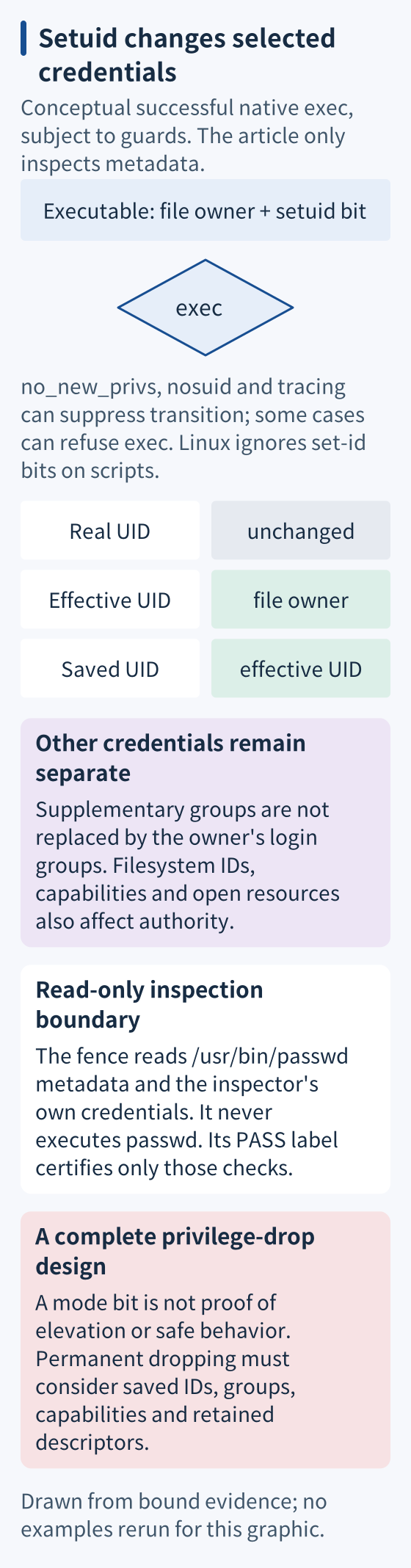
Setuid on a Linux executable can change the process’s effective user ID to the file owner’s ID when exec succeeds. It does not replace every credential with the owner’s login identity. A privileged helper can therefore perform a controlled operation on another account’s behalf, but its input handling and privilege lifetime become part of the security boundary. The mode bit alone proves neither that a transition occurred nor that the helper is safe.
Distinguish the file bit from process credentials
The usual set-user-ID transition changes the effective UID, then copies it into the saved set-user-ID. The real UID remains unchanged. Group credentials are separate: setuid does not automatically install the file owner’s supplementary groups. Linux also has filesystem IDs and capability sets, so real, effective and saved UIDs are useful observations rather than a complete description of authority.
Inspect the deployed file instead of assuming a distribution-wide mode. A privileged password-changing program might be installed differently in a container or customized image. A lowercase s in the owner-execute position indicates both setuid and owner execute; uppercase S indicates setuid without that execute bit. Neither display substitutes for checking ownership, the actual executable, and the process context in which it will run.
Execution can suppress the transition
Linux documents no_new_privs, nosuid mounts and tracing as conditions that suppress the privilege transition; some documented combinations can fail execution instead. File capabilities also have execution constraints. Do not disable one of these protections merely to make a demonstration work. Establish which policy applies to the target path and process, and report the resulting limitation.
Linux ignores set-user-ID and set-group-ID bits on interpreter scripts. Moving a helper from a native executable to a script while preserving its mode therefore does not preserve elevation behavior. Making a general-purpose interpreter privileged is not a safe substitute. Another executable launched by a privileged program may deliberately drop credentials, so running a separate id command is not necessarily a faithful observation of the original helper’s credentials.
Privilege dropping needs a complete design
The setuid system call is distinct from the executable’s mode bit. A sufficiently privileged caller can change real, effective and saved UIDs; an unprivileged caller has a narrower set of permitted transitions. Seteuid can support a reversible effective-UID change when a permitted saved identity remains available. Always check the syscall’s return value before assuming the intended state was reached.
Removing a saved UID is only part of permanent privilege removal. Supplementary groups, retained capabilities, open privileged descriptors, namespaces and later execution paths also matter. A single setuid call is not a universal privilege-drop recipe. The required sequence depends on the program’s existing credentials and resources; security-sensitive helpers need design review rather than a copied one-line pattern.
When it breaks
A mode listing with an s can mask a suppressed transition, while an overly broad helper can expose real authority through unsafe path lookup or user-selected configuration. Loader protections restrict dangerous environment variables in secure-execution mode, but they do not validate the application’s inputs. Avoid shell-based command construction and define exactly which files, arguments and operations the helper may use.
Capabilities can narrow a particular grant, such as permission to bind privileged ports, without making every other permission disappear. Existing user access and other capabilities still apply, and capability bounding and securebits rules qualify root behavior. Likewise, namespace-local root is not host root, but mapped ordinary-user permissions remain meaningful. Socket activation can supply an already-open listener; it does not remove the need to secure the service handling it.
Check it quickly
On Linux with Bash, GNU stat, util-linux findmnt, libcap getcap and Python 3, run the complete block below. It reads one installed file and the new Python process’s own credential status. It never executes passwd, changes permissions, changes credentials, mounts anything or creates a namespace. The explicit pathname avoids a helper search, but separate metadata reads do not atomically bind a later execution to the same file. This review did not run the inspection; assertions require a trusted test environment.
BASH_ENV= bash --noprofile --norc <<'BASH'
set -eu
target=/usr/bin/passwd
test -f "$target"
stat -c 'mode=%A numeric=%a owner=%u group=%g path=%n' "$target"
findmnt --noheadings --output TARGET,VFS-OPTIONS --target "$target"
getcap -v "$target"
python3 - <<'PYTHON'
import os
from pathlib import Path

status = dict(line.split(':', 1) for line in
              Path('/proc/self/status').read_text().splitlines() if ':' in line)
uids = tuple(map(int, status['Uid'].split()))
gids = tuple(map(int, status['Gid'].split()))
assert uids[:3] == os.getresuid()
assert gids[:3] == os.getresgid()
assert len(uids) == len(gids) == 4
for key in ['Uid', 'Gid', 'Groups', 'NoNewPrivs', 'CapEff', 'CapBnd']:
    print(f'{key}:{status[key]}')
print('PASS: inspected metadata and current credentials; target not executed')
PYTHON
BASH
Expect the actual mode and numeric ownership, the filesystem’s mount options, and the target’s capability listing. An empty capability set does not prove absence of the setuid bit, and a setuid bit does not imply a file capability. The Python assertions compare the first three UID and GID fields with the corresponding system-call results; the fourth fields are filesystem IDs.
The PASS line establishes this read-only inspection only. Values vary by host, and no expected root identity is hardcoded. This exercise does not demonstrate elevation, irreversible dropping, or exploit resistance. Those require a separately authorized disposable security test and observations inside the actual helper, without weakening the host’s protections.
Sources
- Linux execve, effective-ID changes, unchanged credentials and suppression conditions, checked 2026-10-15.
- Linux credentials, supplementary groups and filesystem IDs, checked 2026-10-15.
- Linux setuid, privileged and unprivileged transitions and required error checking, checked 2026-10-15.
- Linux seteuid, permitted effective-ID transitions, checked 2026-10-15.
- Linux capabilities, capability limits and credential interactions, checked 2026-10-15.
- Linux dynamic linker, secure-execution environment restrictions, checked 2026-10-15.
- Linux proc_pid_status, credential and capability status fields, checked 2026-10-15.