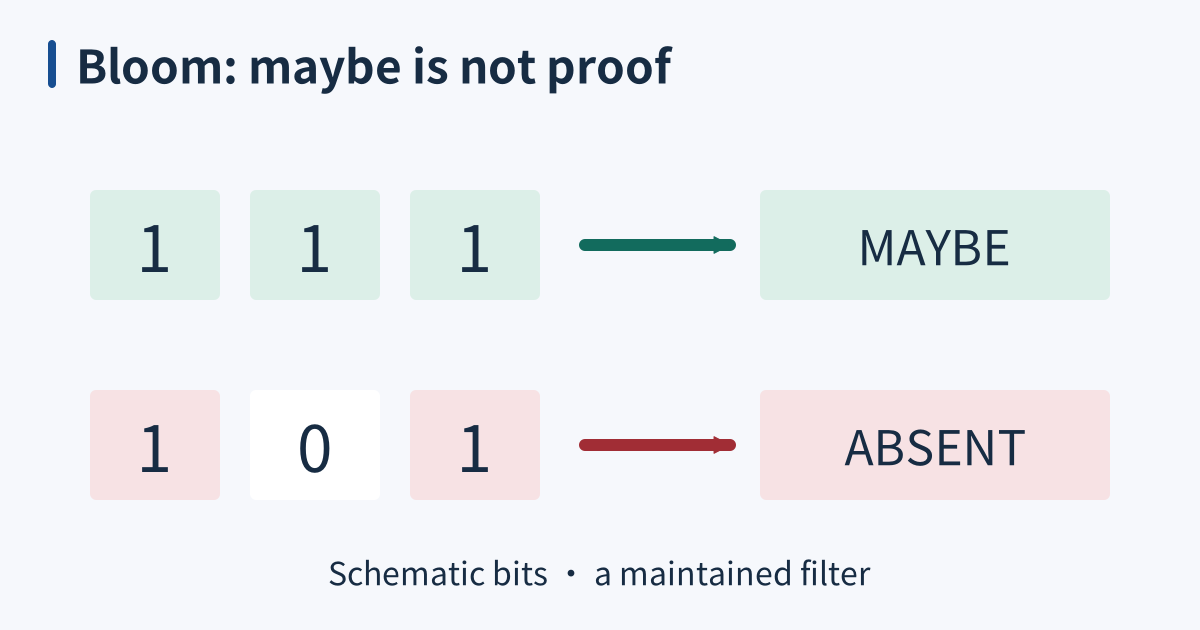
Three required one bits lead to maybe; a required zero leads to absence from the represented set. Schematic positions assume a correctly maintained filter.

A bloom filter answers maybe at low cost

A Bloom filter can cheaply rule out membership in the set it represents, while a positive answer means only “possibly present.” That asymmetry depends on correct updates and unchanged hash rules. A stale or corrupted filter can reject a key that exists in the underlying database, even though the ordinary append-only algorithm has no false negatives for inserted items. ...

December 15, 2027 · 6 min · XB Field Notes
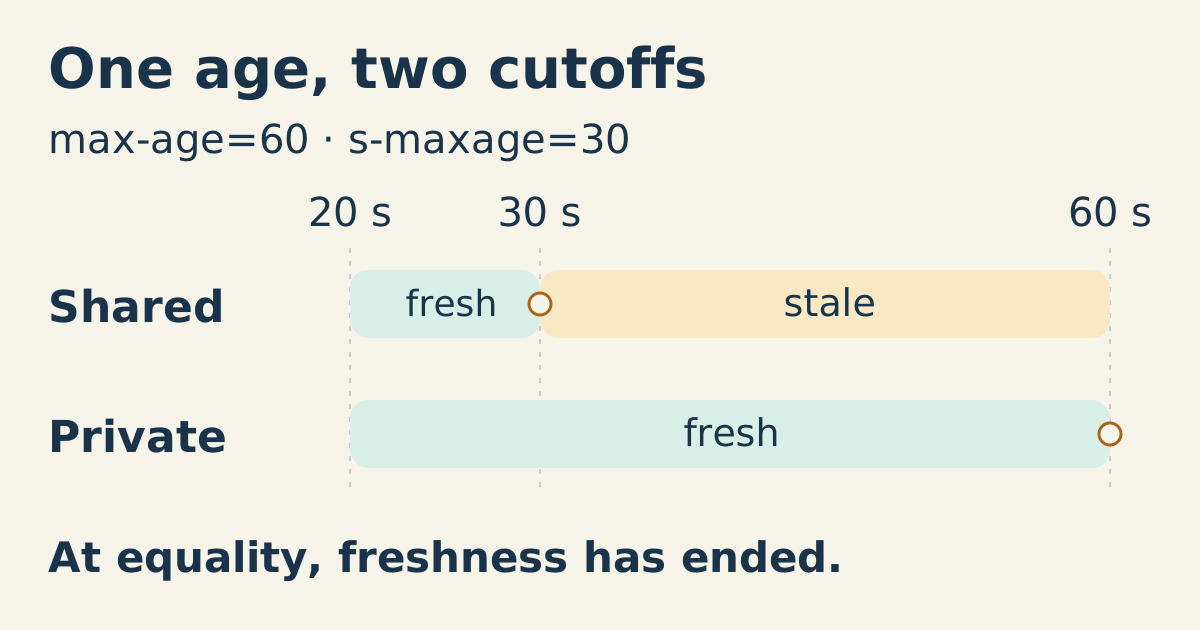
A received Age of 20 reaches the shared freshness boundary at 30 and the private boundary at 60. A separate stale window permits a response with asynchronous validation, not fresh reuse.

Cache freshness is judged against a clock

A cache does not receive a new freshness allowance every time another cache forwards a response. It must account for age already accumulated along the delivery path, then add its own residence time. Otherwise a chain of individually plausible sixty-second caches can keep old content reusable much longer than the origin intended. ...

December 3, 2027 · 5 min · XB Field Notes
For twelve overlapping calls using the same key, the article’s controlled fixture makes twelve loader calls without coalescing, one within one shared Group, and two across two independent Groups. When a wave finishes, the next wave loads again.

A cache stampede hits when expiry syncs

A cache stampede occurs when concurrent misses cause redundant work against the same dependency. Synchronized expiration is one trigger, but eviction, a cold deployment, or cache unavailability can create the same burst. A single popular key can be enough. The useful question is how many rebuilds reach the source while one result is still being computed. ...

November 22, 2027 · 5 min · XB Field Notes
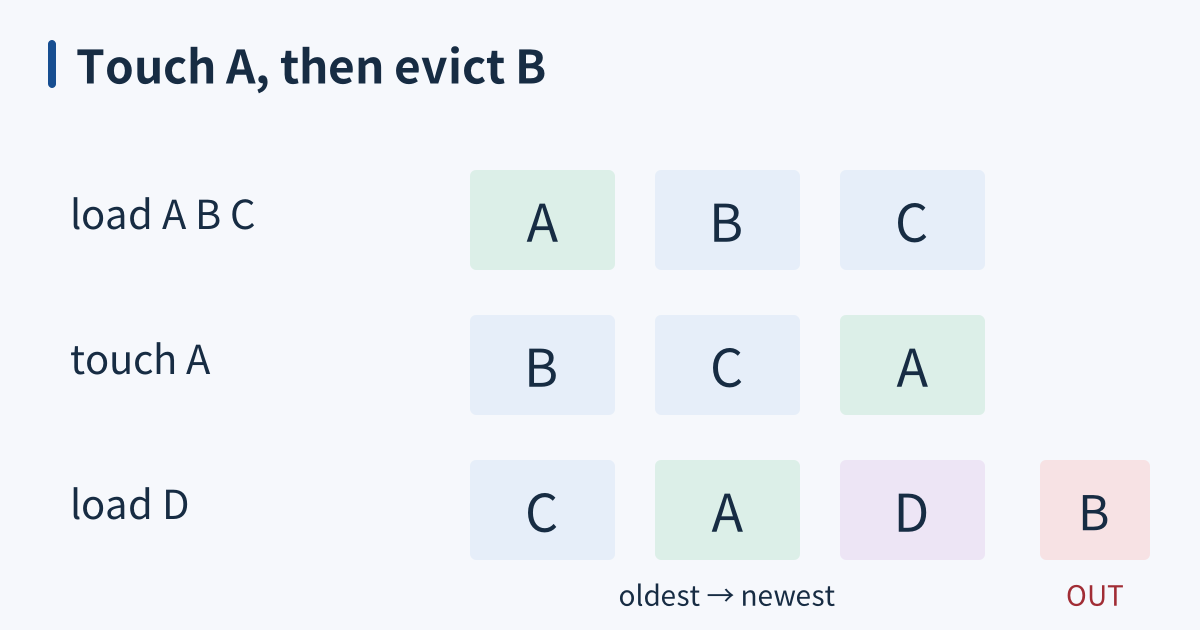
Three oldest-to-newest rows show ABC, BCA after touching A, and CAD after adding D; B is the evicted entry.

An LRU cache evicts the least recently used entry

LRU chooses a victim by recency, not by popularity, age, or business importance. When a bounded cache needs space, an exact least-recently-used policy removes the entry whose last qualifying access occurred longest ago. That rule can exploit temporal locality, but it neither guarantees useful hits nor keeps cached data fresh. ...

November 12, 2027 · 5 min · XB Field Notes
A clockwise ring marks A20, added D35, B50 and C80. The highlighted interval (20,35] moves from B to D while other ownership remains unchanged.

Consistent hashing shrinks the rebalance

Consistent hashing limits placement changes when membership changes; it does not itself move data, make replicas agree, or distribute a hot key’s requests. In the classic clockwise ring, a key belongs to the first node point at or after its hash position, wrapping to the smallest point when necessary. ...

September 19, 2027 · 6 min · XB Field Notes
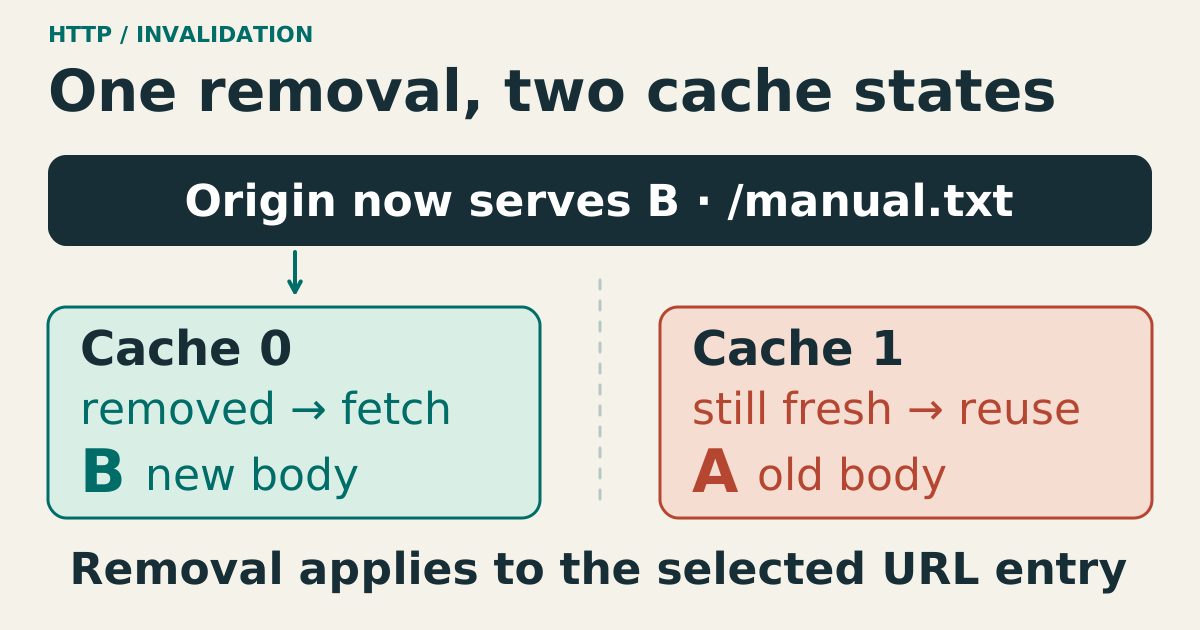
The origin now serves B at /manual.txt. Cache zero’s exact entry is removed, so its next request fetches B. Cache one is independent and still holds fresh A, which it reuses. One targeted removal does not synchronize both caches.

Cache invalidation is a push, not a prayer

Changing an origin does not notify every cache that already holds its response. Invalidation is about controlling which stored copies remain eligible for reuse, not merely updating a file. A reliable release distinguishes expiration, validation, targeted removal, and choosing a new URL. These mechanisms have different scopes, and none remotely erases every copy a reader has downloaded. ...

August 5, 2027 · 5 min · XB Field Notes
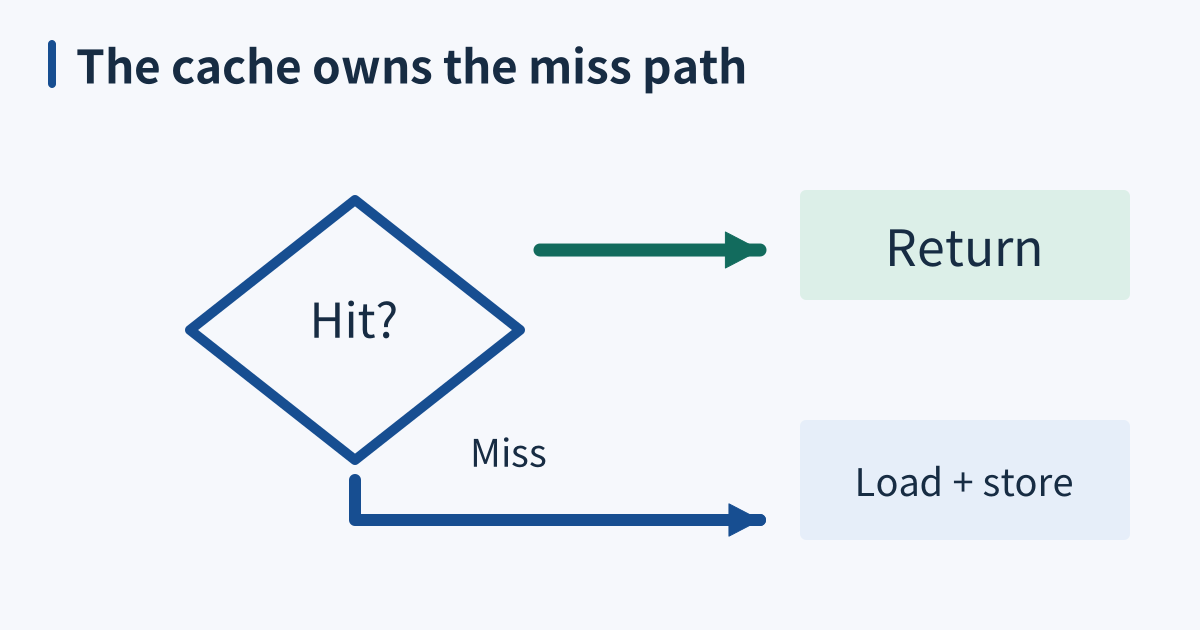
A cache-hit decision returns a stored value directly; the miss branch loads and stores a result.

The cache owns the miss path: schematic.

A read-through cache loads on a miss by itself

Read-through caching gives callers one reading interface: a hit returns a stored value, while a miss invokes a loader and stores its result. The important boundary is who owns that loader. Moving it behind the cache interface can remove duplicated lookup logic, but does not automatically solve concurrency, writes, authorization, or consistency between independent copies. ...

May 26, 2027 · 5 min · XB Field Notes
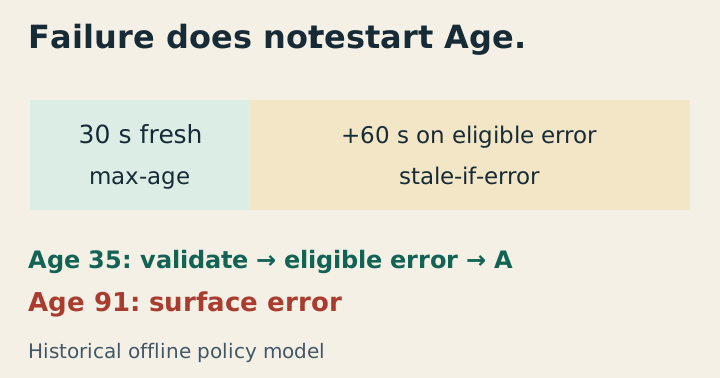
A proportional 30-second freshness segment is followed by 60 seconds of stale-if-error allowance. In the historical offline model, age 35 requires validation before an eligible error keeps A; age 91 surfaces the error. Failure does not restart Age.

Stale cache needs a bounded policy

A stale response can preserve access to a public manual during an origin outage. It can also preserve an obsolete price, revoked permission, or misleading status. Availability is not automatically more important than correctness. Choose the information that may remain usable, the conditions that permit reuse, and the maximum tolerable age before enabling this behavior. ...

February 1, 2027 · 6 min · XB Field Notes