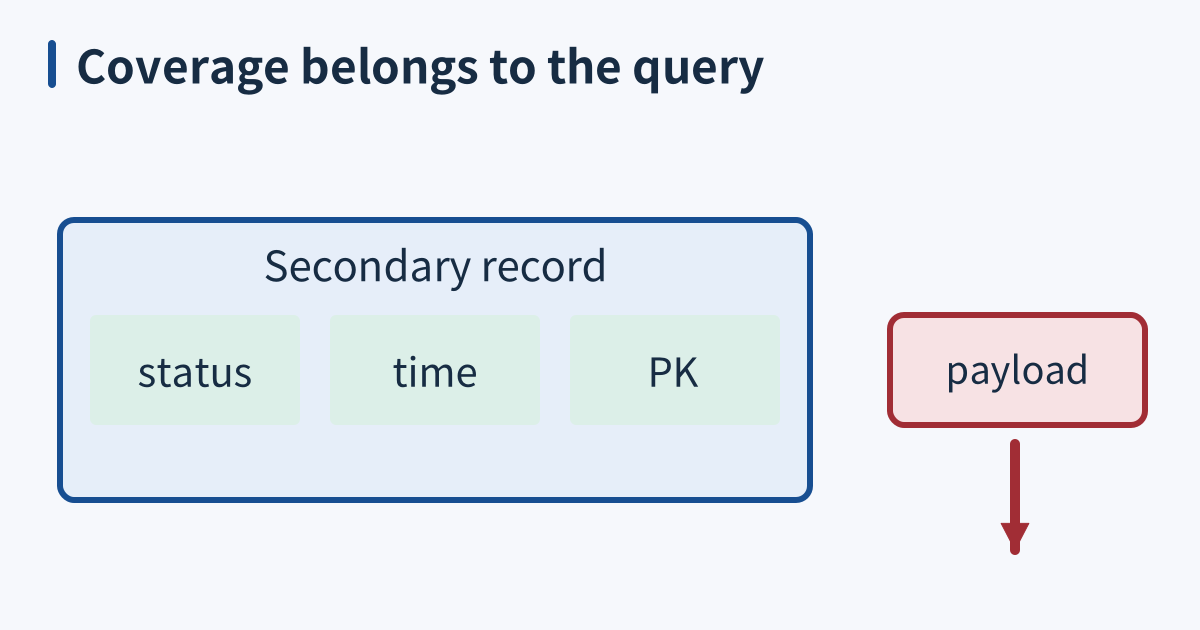
A secondary-record outline encloses status, time and primary-key fields, while a separate payload block points outside the record.

InnoDB covering indexes carry the query's columns

A covering index contains the columns needed to evaluate a particular query and return its requested values. In InnoDB, secondary-index records also carry the primary-key columns, so a query can be covered without explicitly listing the primary key again in the secondary-index definition. Coverage is a relationship between one query and an index, not a permanent property that applies to every query against the table. ...
March 3, 2028 · 5 min · XB Field Notes
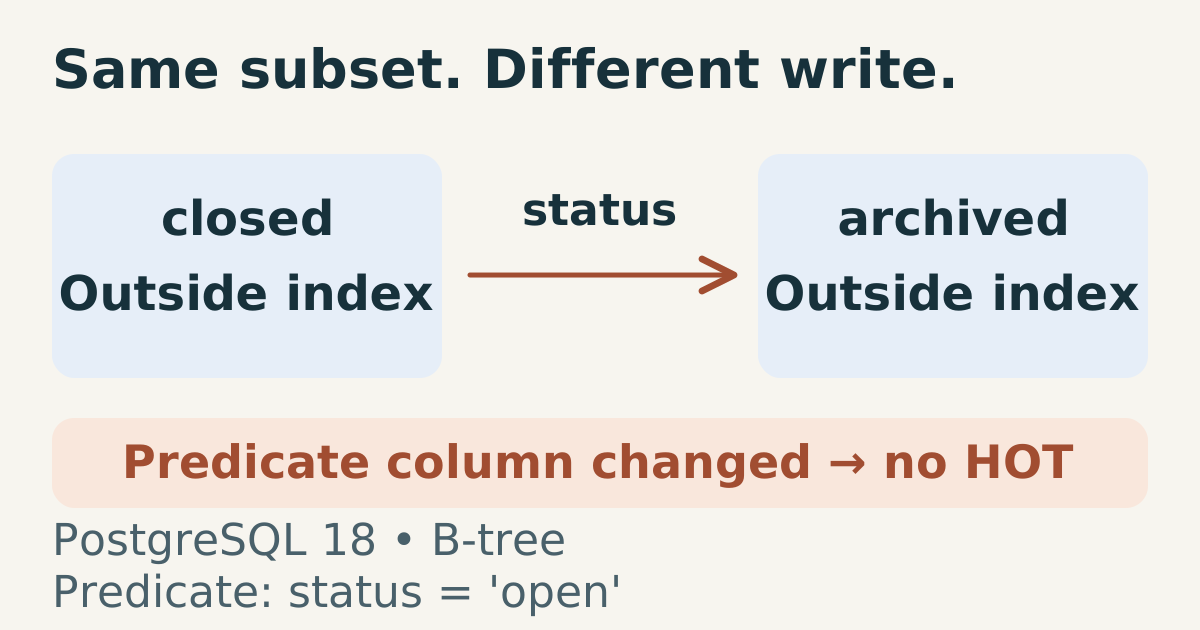
A closed row changes to archived. Both states remain outside an open-only index, but changing the predicate column blocks HOT in the PostgreSQL 18 B-tree example.

Partial indexes and writes

A partial index filters rows, not columns. An index on id WHERE status = 'open' stores identifiers for open rows; status decides membership without becoming the search key. That distinction matters when estimating maintenance: a column need not appear in the stored key to affect an update’s cost. ...

February 15, 2028 · 5 min · XB Field Notes
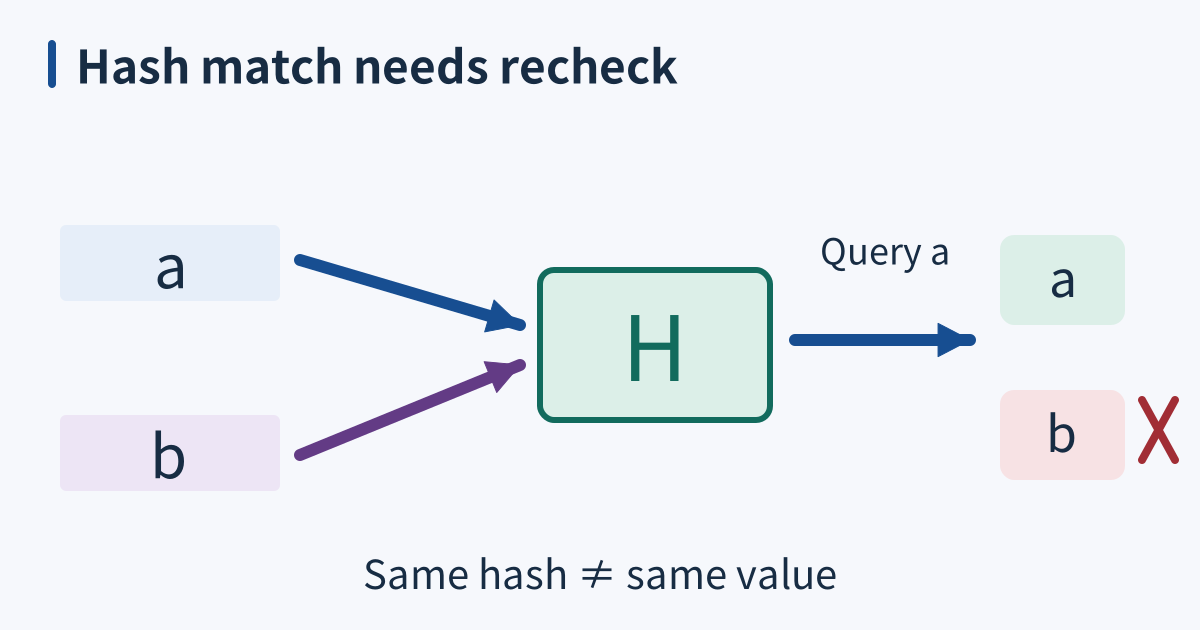
Different values a and b converge into the same hash H; the original-value check keeps a and marks b rejected.

Hash indexes recheck collisions and maintain changed keys

PostgreSQL hash indexes narrow an equality search using a hash code, then verify the original value in the table. A hash match is a candidate, not proof of equality. Two different values can have the same code, and different codes can also map to the same bucket. Neither collisions nor shared buckets imply incorrect query results when the normal recheck is performed. ...

January 24, 2028 · 5 min · XB Field Notes
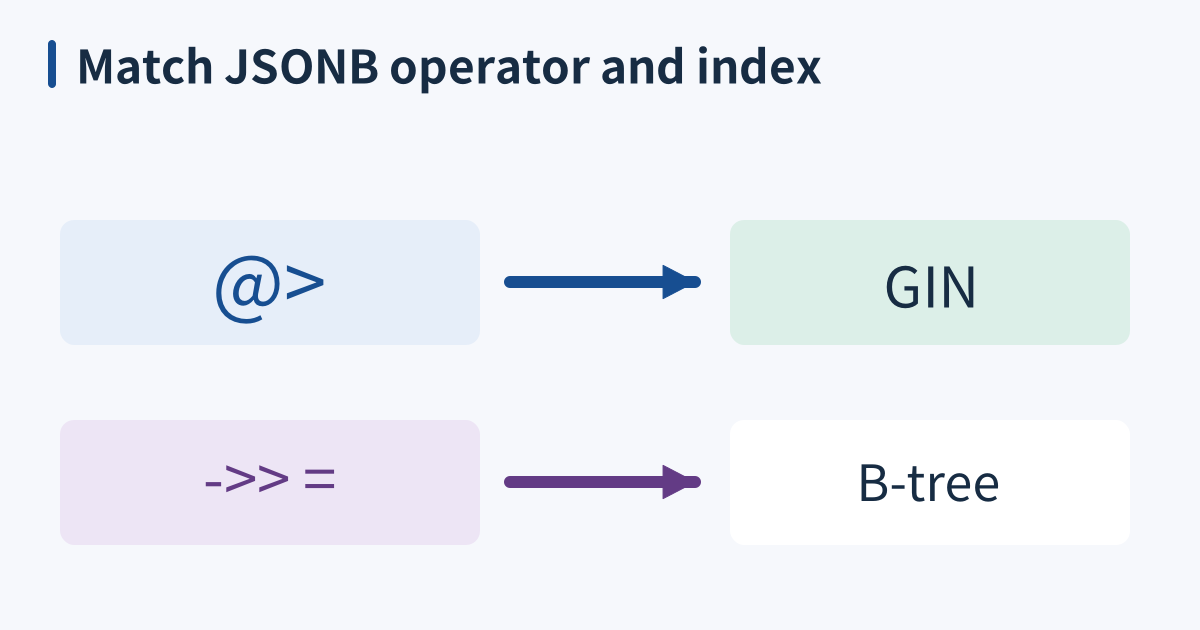
Two independent horizontal paths connect document containment to GIN and extracted-text equality to B-tree.

Postgres JSONB pairs with GIN for flexible queries

A PostgreSQL JSONB column can hold documents with different shapes, but efficient querying still requires a precise contract between the predicate and the index. A GIN index on the whole document supports particular JSONB operators. It does not automatically accelerate every expression that extracts a field from that document. ...

July 28, 2027 · 5 min · XB Field Notes
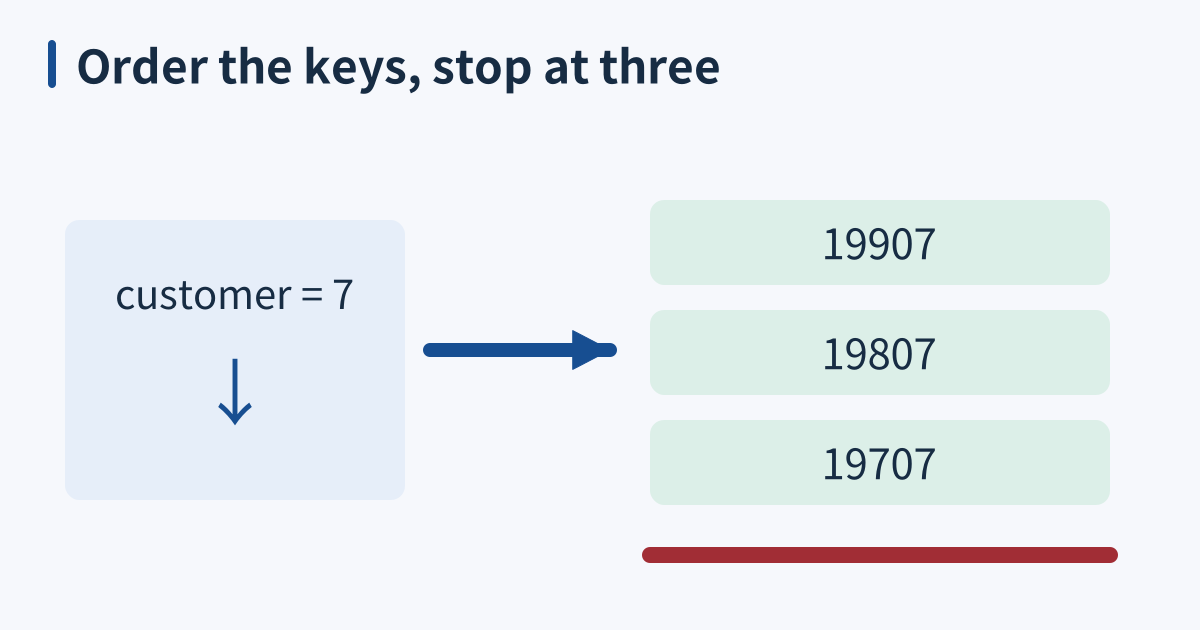
A customer-equality block points to three descending identifier bars, with a red stop line directly beneath the third.

A Postgres index lives to answer a query

An index is valuable because it changes the work needed by a real query. Counting indexed columns is not a useful success measure. A narrow B-tree that finds one customer’s newest three orders can outperform a wider structure that cannot supply the needed ordering, while a query reading almost every row may correctly ignore both. Evaluate access, ordering, and result volume together. ...

July 20, 2027 · 5 min · XB Field Notes
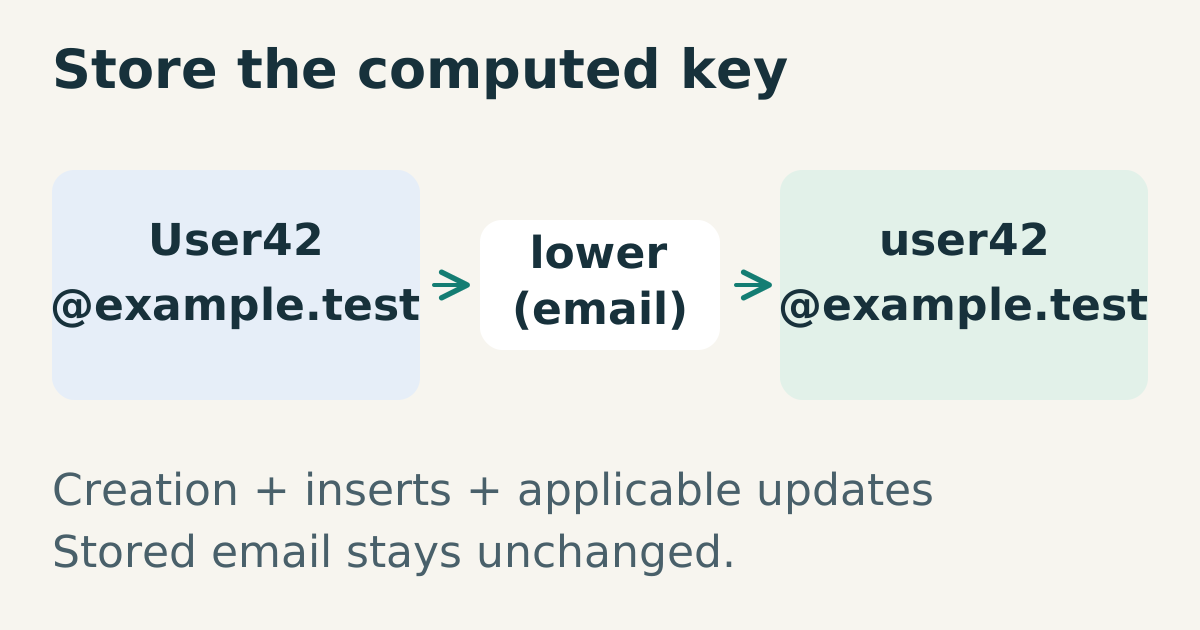
The stored email User42@example.test stays unchanged while lower(email) supplies the index key user42@example.test. Keys are computed at creation and maintained on inserts and applicable updates.

A function index precomputes a value at write time

An expression index stores the result of a computation as an index key. A query comparing lower(email) can search those precomputed keys instead of evaluating lower over every table row. This moves work into index creation and maintenance. It does not change the stored email, guarantee that every query uses the index, or make every textual variation a different expression. ...

May 5, 2027 · 4 min · XB Field Notes
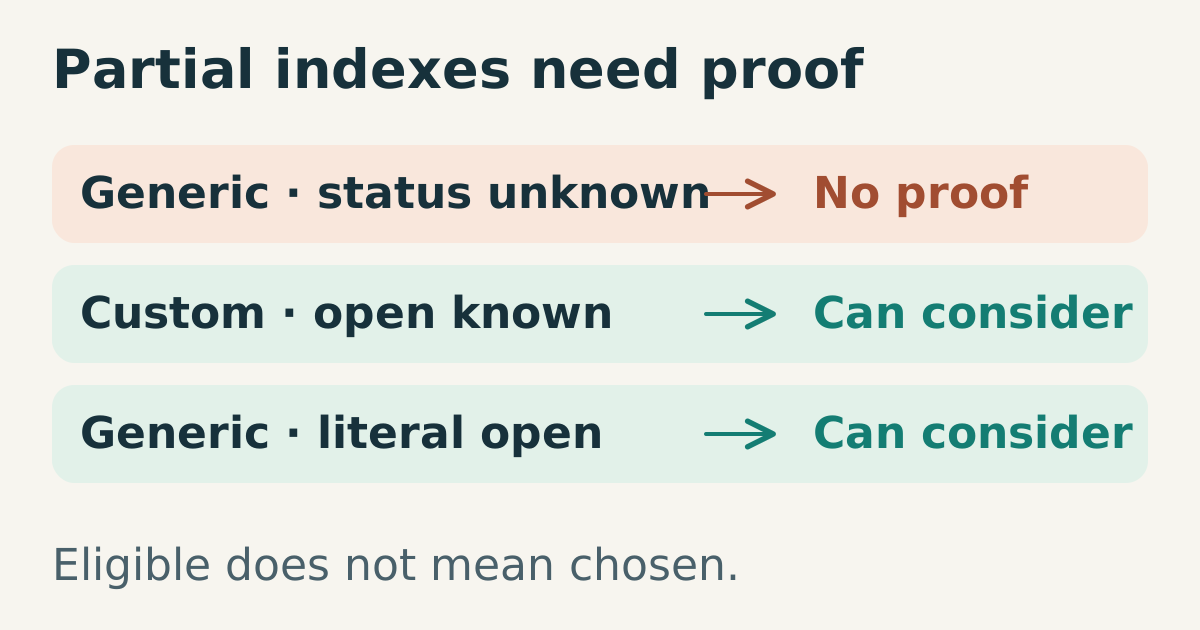
Unknown status in a generic plan cannot prove open-only membership. A custom plan knowing open, or a generic query with literal open, can consider the partial index. Eligibility does not guarantee selection.

A partial index stores only the rows that matter

A partial index can keep a frequently queried subset of rows in a smaller structure. An index on job id WHERE status is open is a useful candidate when open jobs are rare and most requests target them. Its availability depends on what the planner can prove about each query, not merely on whether the application happens to pass “open” during one execution. ...

April 27, 2027 · 5 min · XB Field Notes
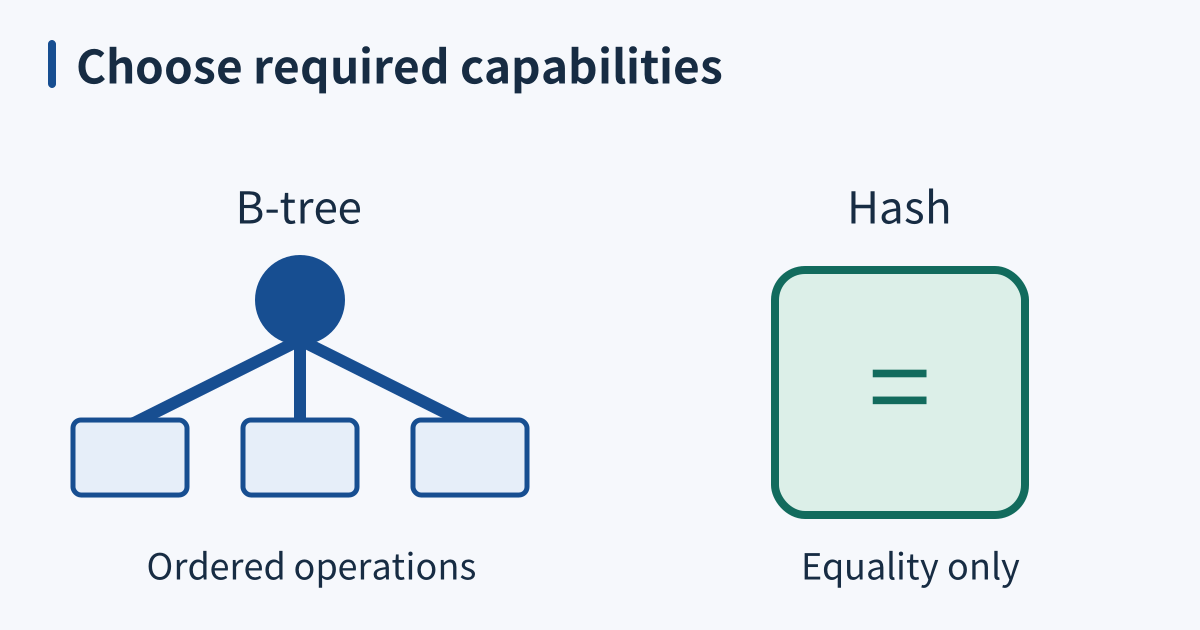
An ordered branching B-tree silhouette contrasts with one hash bucket containing an equals sign.

Choose B-tree or hash from the required operations

PostgreSQL’s default B-tree index supports several common query requirements: equality, ranges, ordered access, and uniqueness enforcement. A hash index supports a narrower equality access path. Choosing between them starts with the required operators and constraints, then proceeds to measurement. Saying that hashes are always faster for equality, or that PostgreSQL almost never chooses them, replaces a workload question with an unsupported generalization. ...

February 7, 2027 · 5 min · XB Field Notes