A u, g and m declaration points to a missing service user being created and linked to its primary and supplementary groups.

systemd-sysusers creates missing service accounts

A service package often needs a dedicated account before it can own files or run without root. systemd-sysusers describes that account and its groups in a small configuration file. Its central operation is creating missing identities and establishing requested memberships. It is not a general account migration engine, a directory creator, or a guarantee that automatically allocated numeric IDs match on every host. ...
June 8, 2027 · 5 min · XB Field Notes
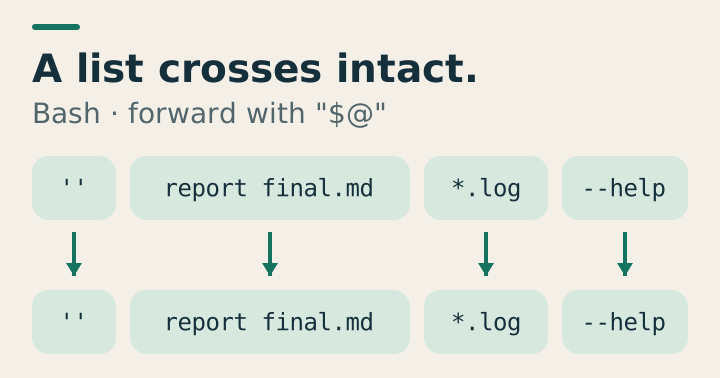
Four exact values retain four boundaries when forwarded with quoted dollar-at.

$@ and friends give a function its whole argument list

A wrapper should pass the arguments it received without changing their boundaries. In Bash, "$@" does that when used as command arguments: each positional parameter becomes a separate quoted word. This matters for empty values, spaces, newlines, and literal wildcard characters. A command that happens to work with two simple filenames can still be broken if its wrapper reconstructs the list as a single string. ...

April 16, 2027 · 4 min · XB Field Notes
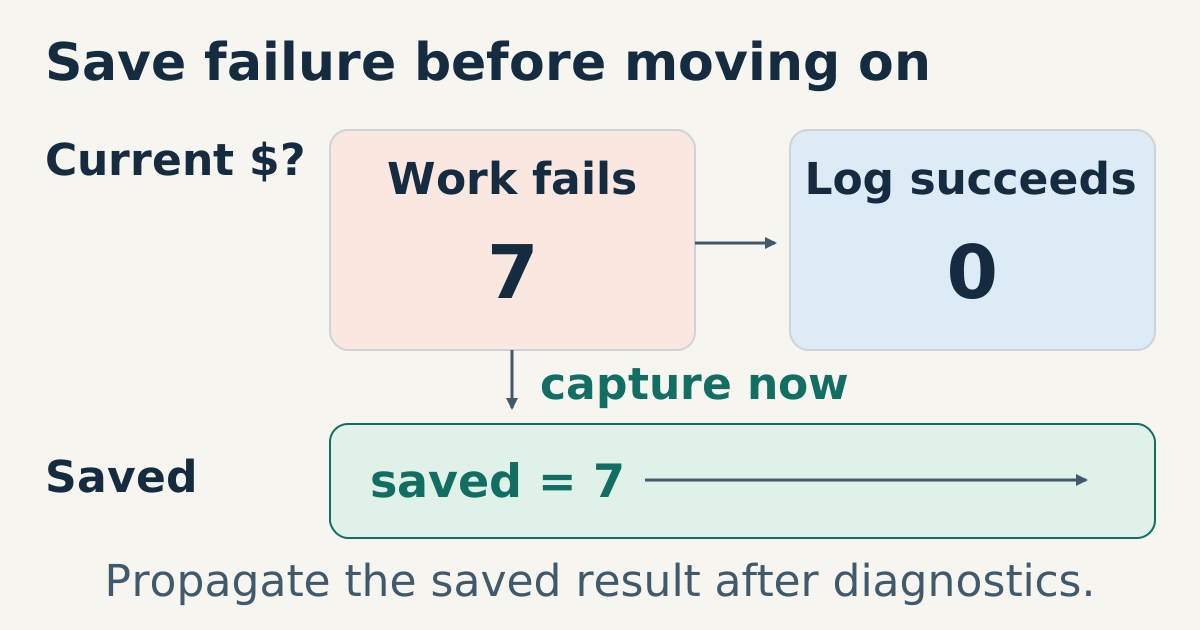
The current-status lane starts with failed work returning 7 and later successful logging returning 0. An immediate capture branches down to a saved=7 lane that persists independently until explicit return or exit.

Exit status is a compact report of what went wrong

An exit status is a small value that a shell uses to decide what runs next. Zero means success for shell control flow; a nonzero status takes the failure branch. That does not give every number a universal application meaning. A search with no matches, invalid input, and an unavailable server may deserve different handling even though all can produce nonzero results. Read the command’s contract before deciding what to retry or ignore. ...

March 27, 2027 · 4 min · XB Field Notes
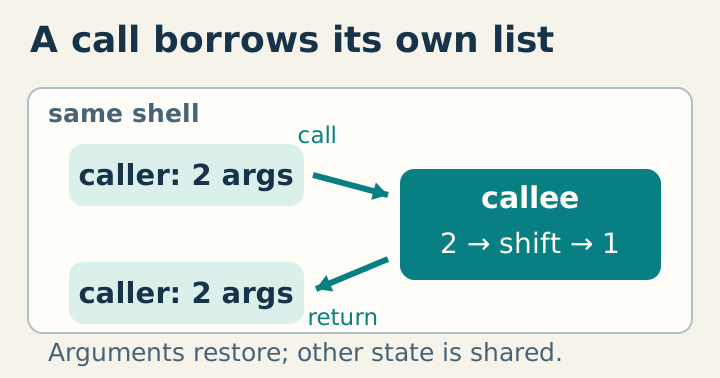
Inside one shared shell, a function gets its own positional list, shifts it, then returns to the unchanged caller list. Shared variables sit alongside those temporary argument frames.

A shell function reads its arguments like a script

A shell function groups commands under a name and receives its own positional arguments. In an ordinary call, its body runs in the current shell rather than automatically starting a separate process. That makes functions useful for reusable operations, but it also means assignments, directory changes, and other shell state can affect the caller. A function needs an explicit contract for inputs, output, status, and any intentional side effects. ...

March 16, 2027 · 5 min · XB Field Notes
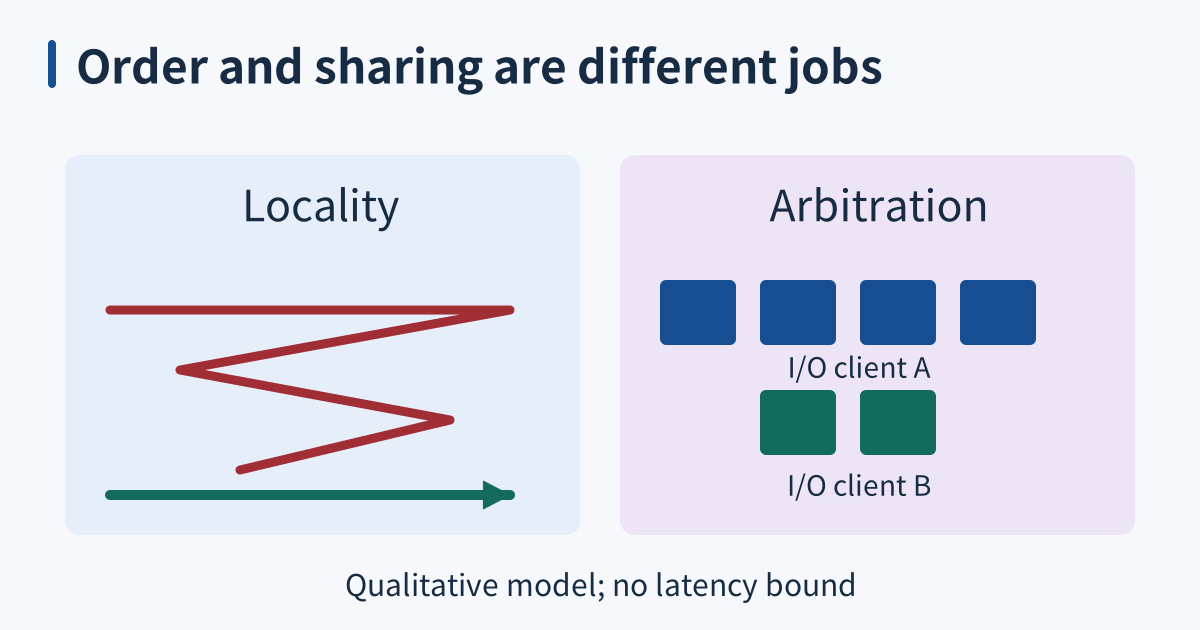
One panel compares zigzag and ordered head-travel paths; another shows separate client A and B request rows. Shapes illustrate locality and competing demand without benchmark or fairness guarantees.

Disk schedulers order I/O to move the head efficiently

blk-mq provides CPU- or node-local software staging queues and hardware dispatch queues. Scheduling and merging can occur before dispatch, while driver and device behavior also affect service. Software submission order does not guarantee completion order. A scheduler can influence how competing requests enter the device without controlling every later decision in the storage stack. ...

March 9, 2027 · 7 min · XB Field Notes
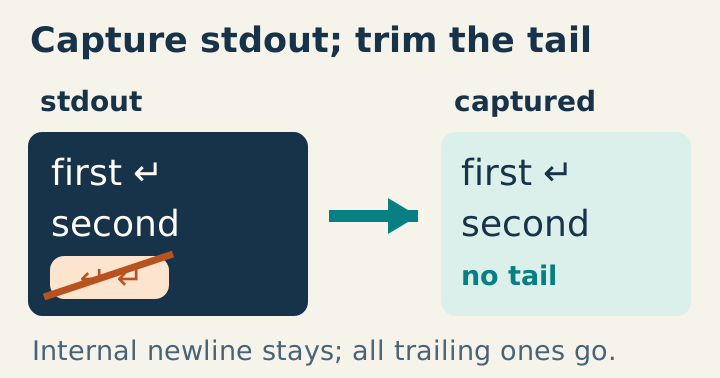
A stdout tape containing first, an internal newline, second and two trailing newlines becomes captured text first newline second; the internal newline stays and both trailing newlines are removed.

Command substitution puts one command's output into another line

Command substitution captures a command’s standard output and inserts the resulting text into a surrounding expression. The familiar $(command) form is useful for a timestamp, a computed label, or another small textual value. It is not a transparent channel for arbitrary bytes or a reliable way to transport a list of filenames. Its newline handling, execution environment, and exit status are part of the interface you need to understand. ...

March 3, 2027 · 5 min · XB Field Notes
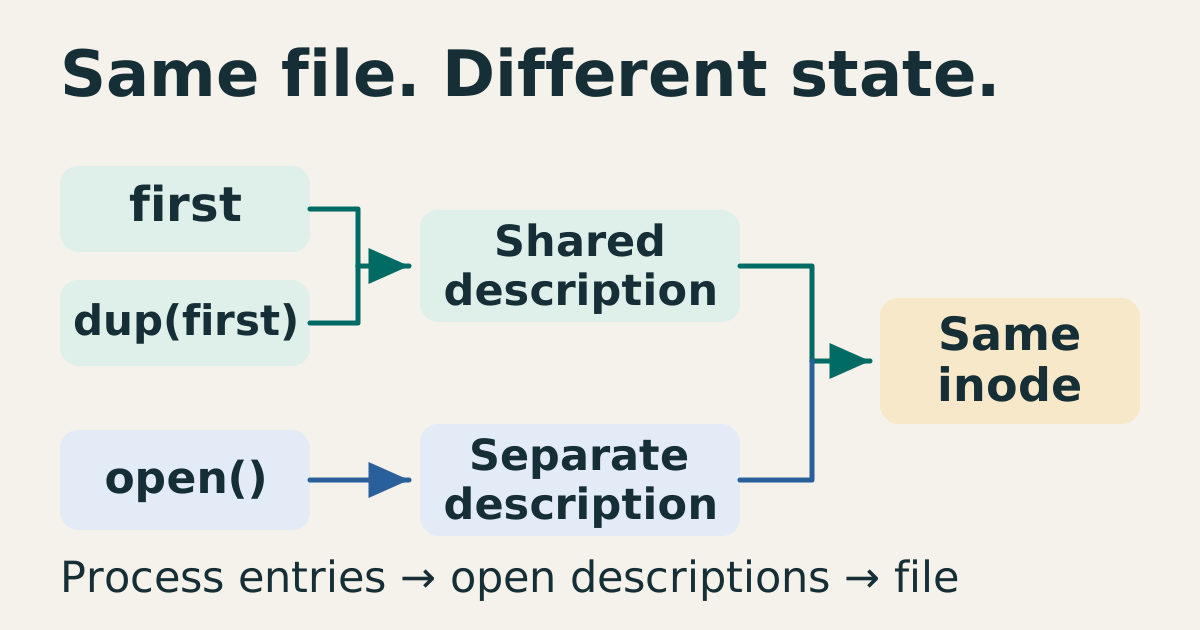
first and dup share one open file description, while a separate open has its own description; both descriptions reference the same inode.

File descriptors name a process’s open references

A file descriptor is a small integer used within one process to refer to an open resource. The process’s descriptor table maps that number to an open file description maintained by the kernel. For a regular file, the description includes the current offset and file status flags. Another process can use the same integer for a completely different resource, so the number alone is not a global file identity. ...

February 21, 2027 · 5 min · XB Field Notes
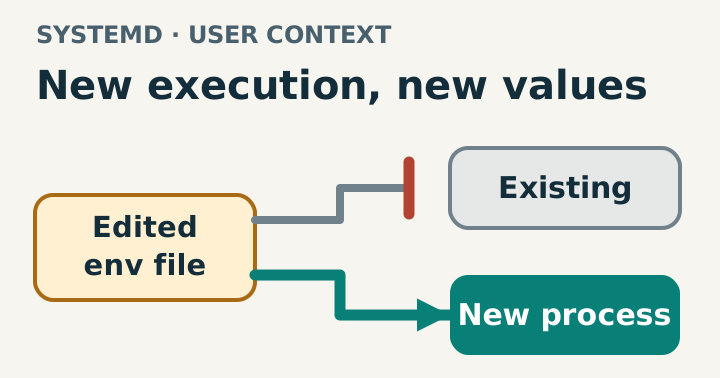
An edited environment file branches toward two process boxes. A stop bar blocks the route to an existing process, while an arrow delivers values to a new process.

EnvironmentFile supplies values when systemd executes a process

An environment file separates deployment values from the unit definition that describes process supervision. systemd reads the configured file before executing a service command and supplies those values in that process’s environment. Editing the file does not rewrite the environment of an already running process. A reload helper is another process, however, and can receive newer file values than the service’s existing main process. ...

February 19, 2027 · 5 min · XB Field Notes