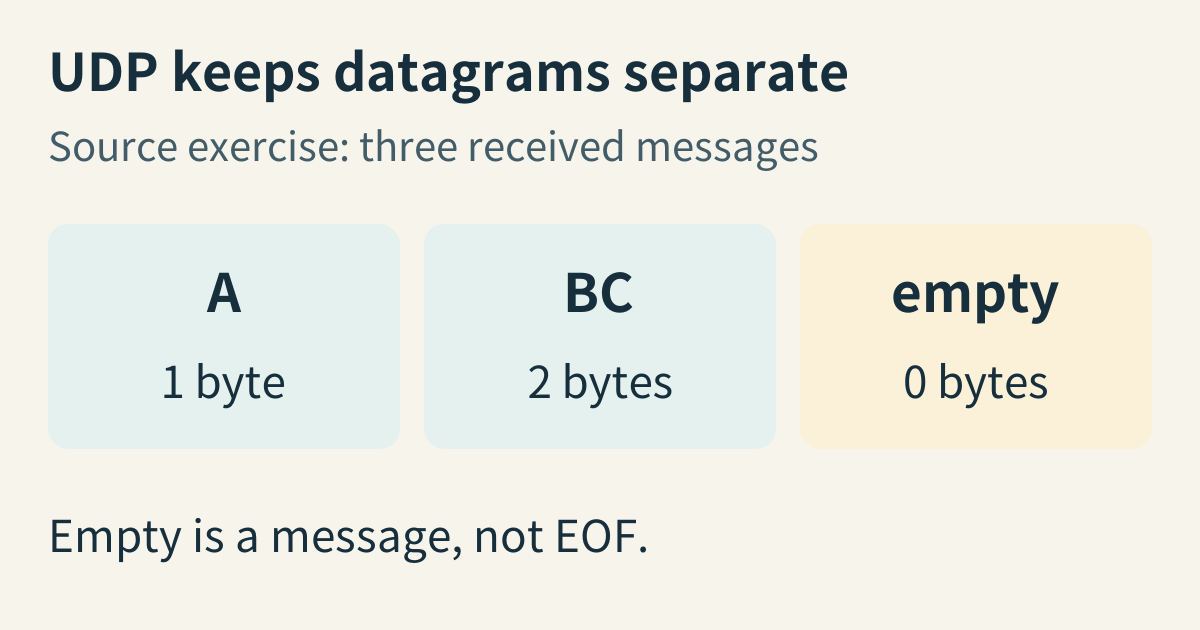
Three separate datagram cards show A with 1 byte, BC with 2 bytes, and empty with 0 bytes. The empty payload remains a message and is not EOF.

UDP preserves datagrams; recovery and timing belong to the application

UDP carries discrete datagrams between transport endpoints. Its eight-byte header contains source port, destination port, length, and checksum fields. The protocol does not add TCP’s reliable ordered byte stream or its congestion-control behavior. This gives applications room to choose their own delivery policy, but it does not promise lower latency for every workload. A missing datagram can be more costly than a handshake when the application needs its contents. ...
November 11, 2026 · 5 min · XB Field Notes
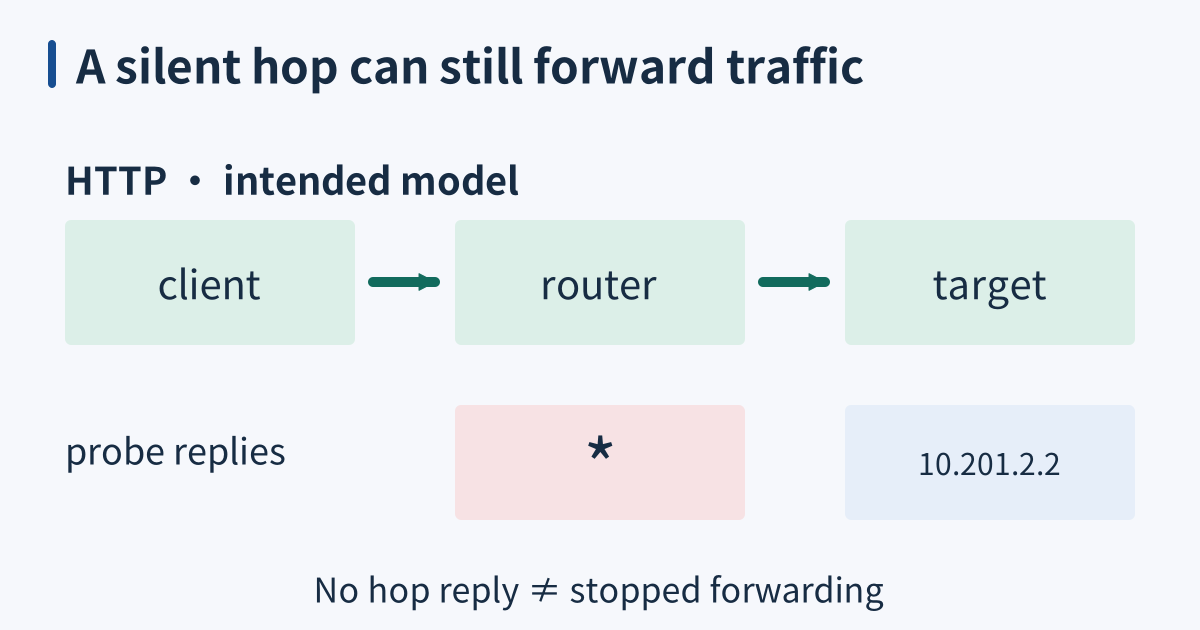
Intended source scenario, not an observed run. An HTTP forwarding row connects client through router to target. The probe-reply row under the router is a star while the target still replies as 10.201.2.2. A missing intermediate diagnostic reply does not establish stopped forwarding.

Traceroute reports probe replies, not a complete map of forwarding health

Traceroute sends probes with increasing TTL values to discover where packets expire and which systems report that expiration. An IPv4 router forwarding a packet decrements its TTL; when it expires, an ICMP Time Exceeded response normally identifies a responding hop. A traditional UDP trace finishes when the destination reports an unused port. The output is a series of observations about probes and replies, not a guaranteed inventory of every forwarding device. ...

November 5, 2026 · 6 min · XB Field Notes
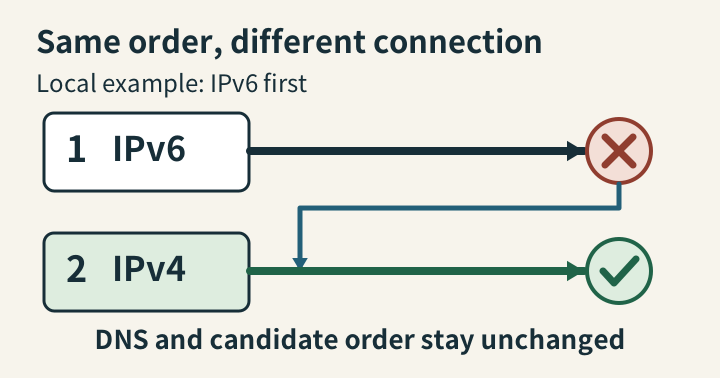
In the article’s local example, IPv6 remains first in the candidate list but its stopped listener refuses the connection; the sequential client then succeeds through IPv4.

Dual-stack address ordering and successful connection choice are separate

Discovering A and AAAA records provides possible destinations. It does not select a successful connection by itself. Address ordering, source-address selection, routing, and the application’s connection algorithm all contribute. RFC 6724 describes default source and destination selection rules, while applications can impose their own choices. A program requesting only IPv4 has already narrowed the result before any dual-stack connection strategy can act. ...

November 4, 2026 · 6 min · XB Field Notes
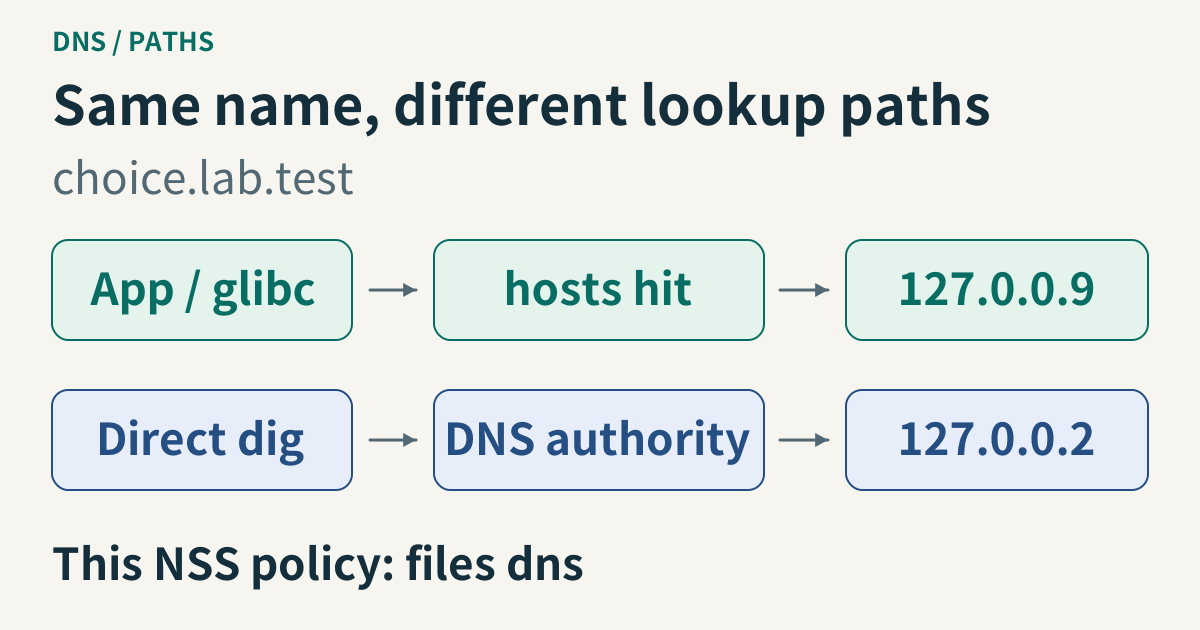
Two paths resolve choice.lab.test. A glibc application using files dns returns the hosts-file address 127.0.0.9; a direct dig query to the DNS authority returns 127.0.0.2.

Resolution order depends on the application and its name-service path

A hostname lookup starts with the program making it. On Linux, an application using glibc name-service interfaces can consult the services listed for hosts in /etc/nsswitch.conf. A program with its own DNS client may take a different path. There is no universal sequence in which every application checks a cache, then a hosts file, then the internet. ...

August 2, 2026 · 6 min · XB Field Notes