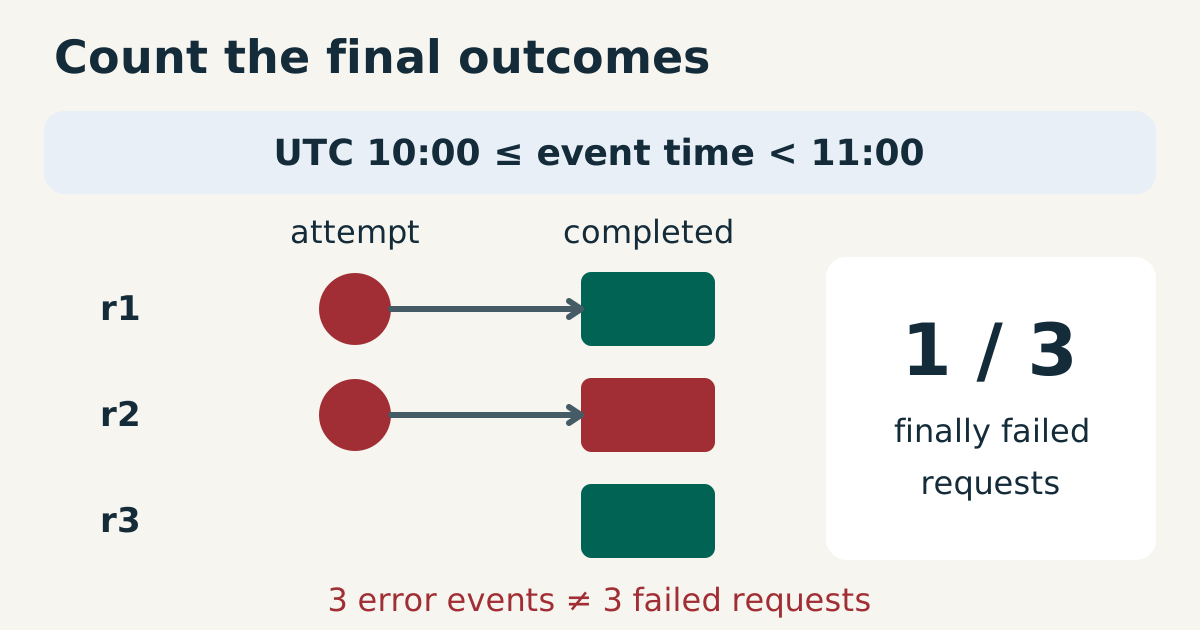
Within the fixed UTC interval from 10:00 inclusive to 11:00 exclusive, request one has a failed attempt then a successful completion; request two has a failed attempt and failed completion; request three completes successfully. Three error events correspond to only one failed completed request out of three.

Give a log query a question and a denominator

A useful logging design starts with a question precise enough to become a query. “Show errors” is different from “How many checkout requests finally failed between ten and eleven UTC?” The first locates diagnostic events. The second needs a population of completed requests, a definition of failure, and a time rule. Collecting more text does not supply these missing semantics automatically. ...
September 6, 2026 · 5 min · XB Field Notes
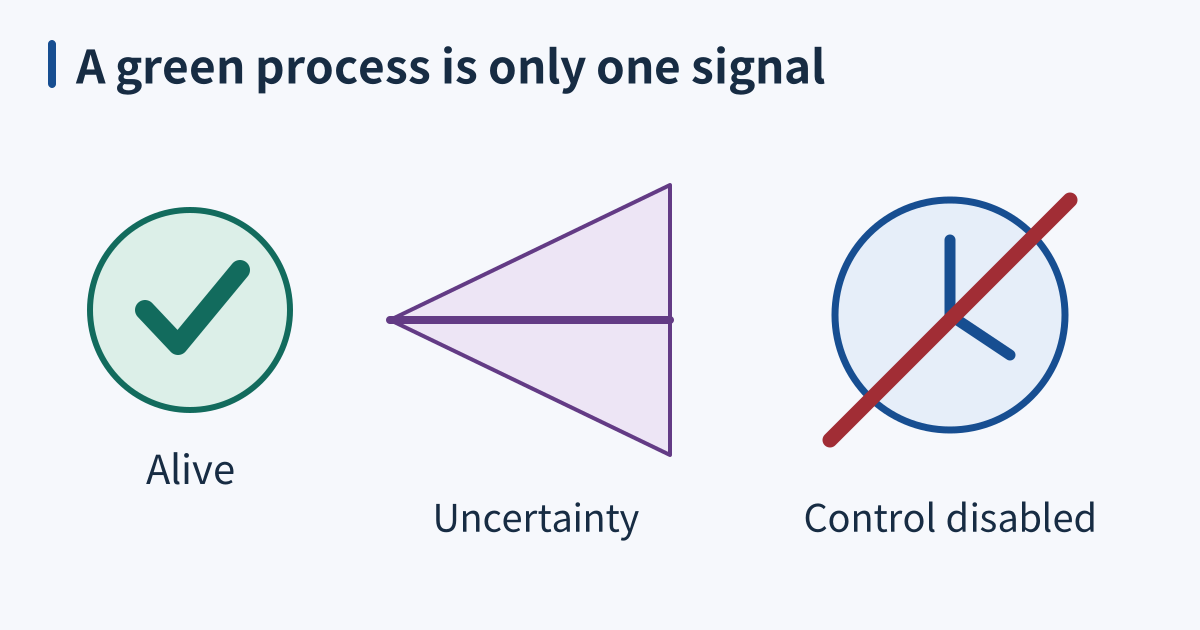
Three distinct symbols in the source counterexample: a live-process check, an uncertainty fan and a clock with control crossed out.

Servers need observable time discipline

A time daemon is useful only when its operating state supports the application’s time requirements. A running process can have no usable source, and a selected source can still be wrong or insufficiently measured. Treat time service health as an observable chain: source configuration, successful observations, selection, uncertainty, and permitted clock control. A green process indicator covers only the beginning. ...

September 2, 2026 · 6 min · XB Field Notes
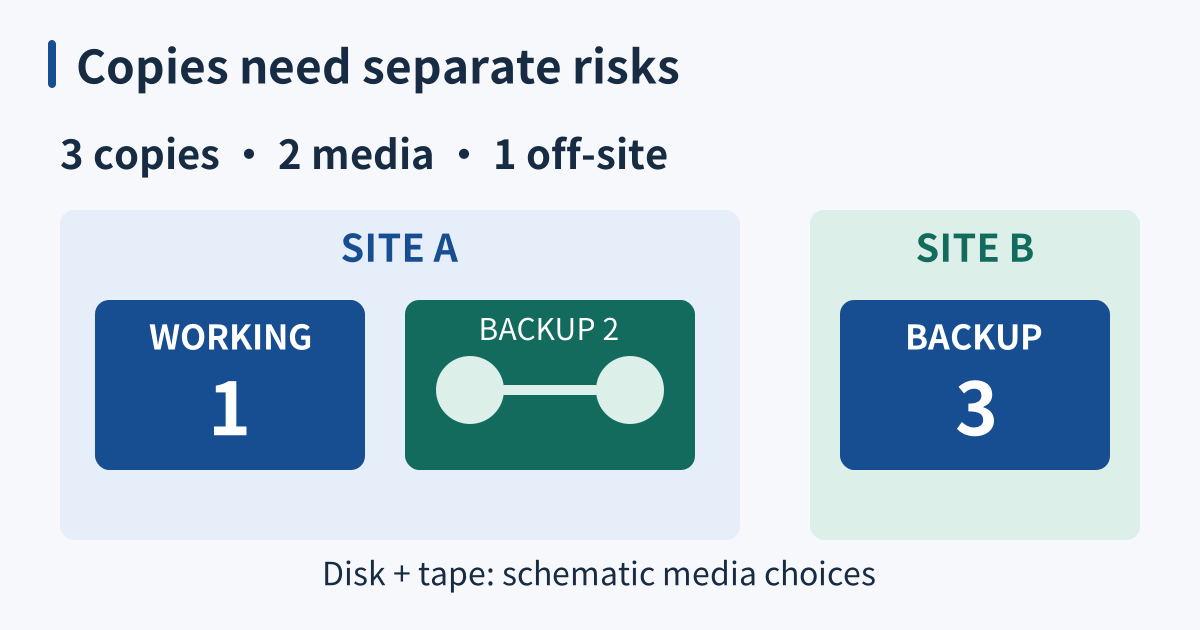
A 3-2-1 design schematic puts working copy 1 and tape backup copy 2 at site A, and disk backup copy 3 at site B. Two media and one off-site location are illustrated, not measured.

Backups follow the 3-2-1 rule

The classic 3-2-1 backup rule calls for three copies of data, on two storage media, with one copy off site. The working data counts as one copy, leaving two backup copies. The rule is a starting point for separating failure exposure. It does not promise that every set of three filenames survives hardware failure, accidental deletion, credential compromise, or a mistake propagated to all copies. ...

August 30, 2026 · 4 min · XB Field Notes
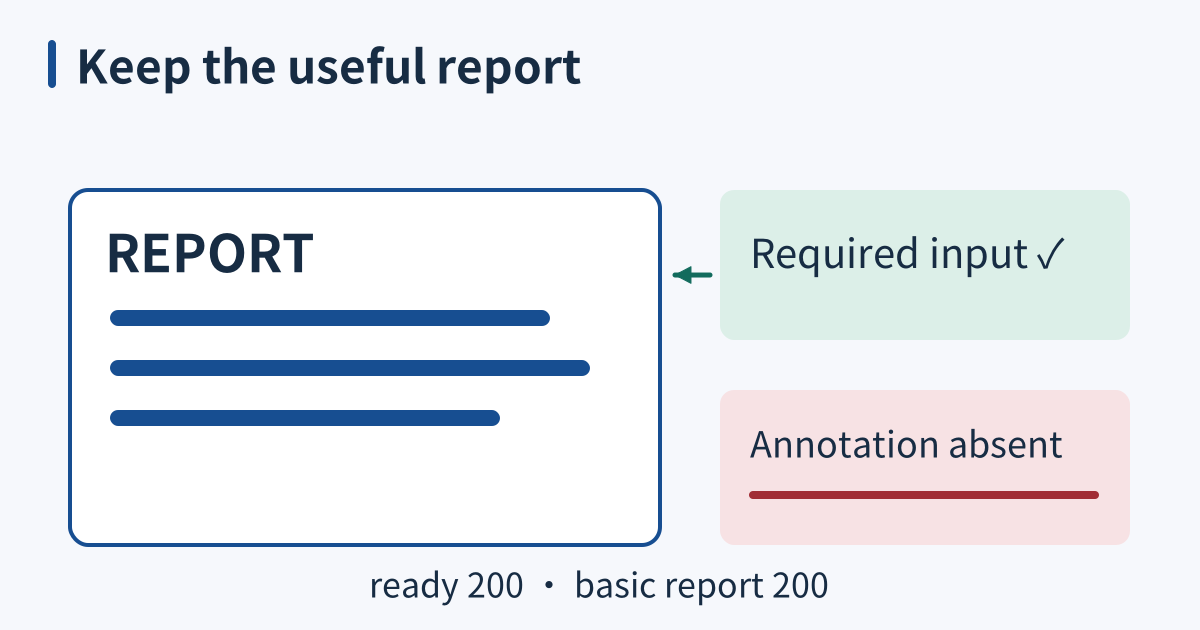
The basic report remains available when its required input works and its optional annotation is absent. The declared policy keeps readiness and the basic report at 200.

Health endpoints answer a question

A health endpoint is an input to an operational decision, not a universal certificate that a service works. A small endpoint returning 200 can be useful when its consumer needs exactly that limited evidence. Problems begin when operators interpret “this handler answered” as “every customer request will succeed.” ...

August 19, 2026 · 6 min · XB Field Notes
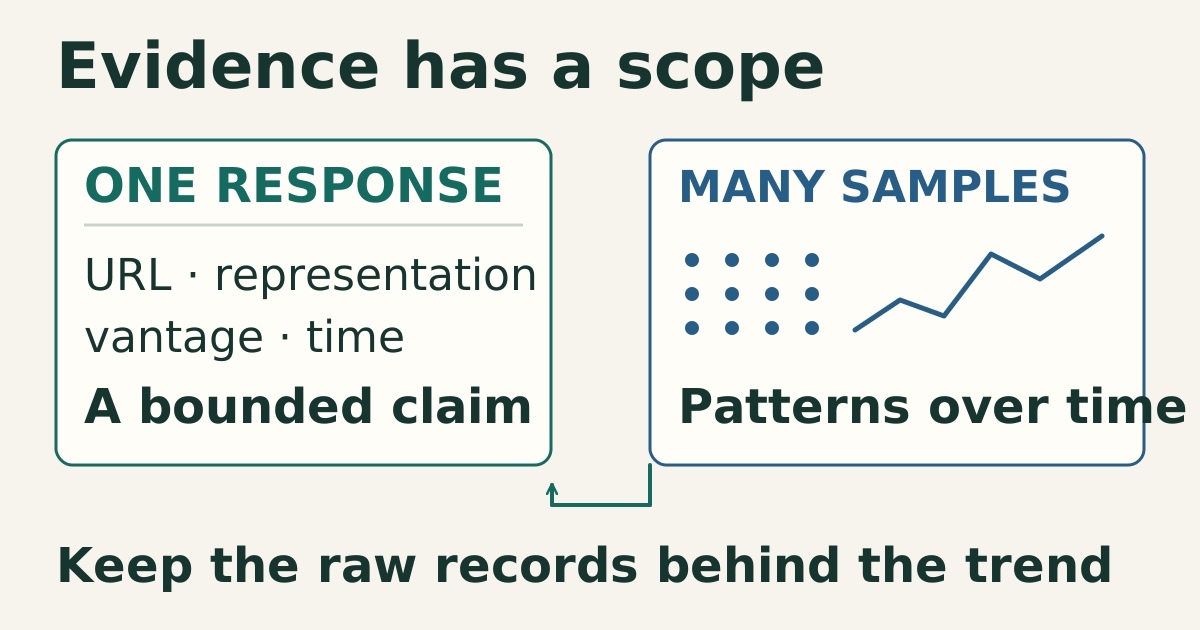
A single response record is bounded by URL, representation, vantage point and time. Beside it, many observations form an aggregate trend whose provenance links back to the raw records.

Readable evidence before dashboards

Prefer a verifiable sentence over a colored panel when the claim has to survive an audit.

August 18, 2026 · 4 min · XB Field Notes
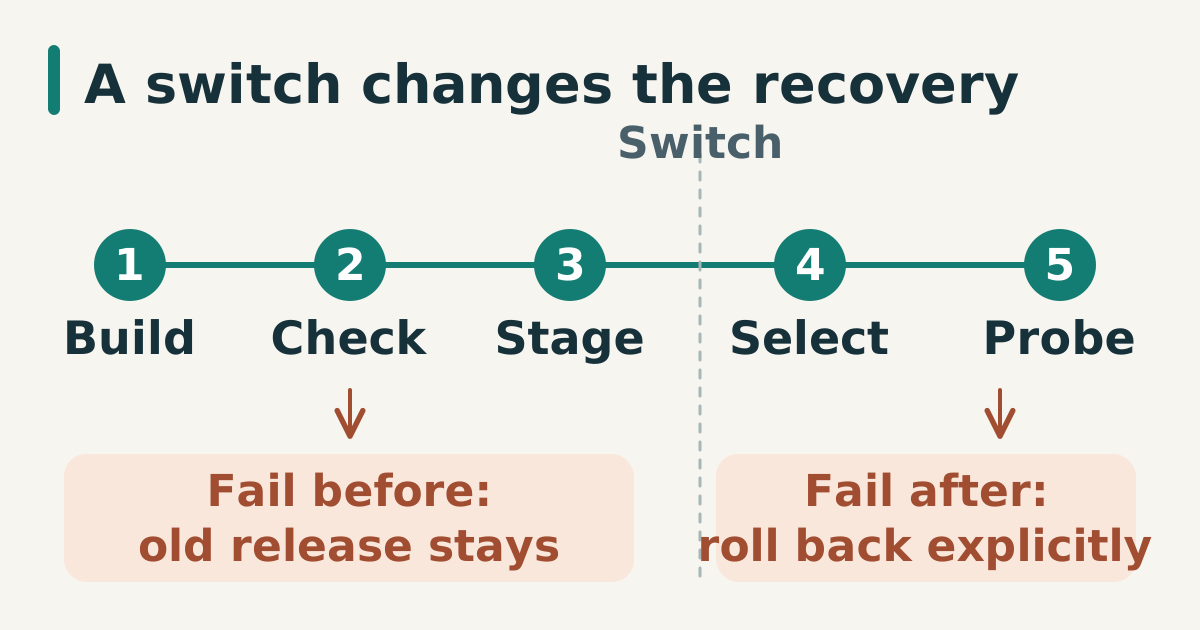
Build, check and stage precede a marked selection boundary, then a sampled edge check follows. Failure before selection leaves the old release; failure after selection requires explicit rollback.

Ship a static site and prove the edge agrees

Build, publish, and check delivery while keeping artifact identity, sampled observations, and rollback distinct.

August 11, 2026 · 8 min · XB Field Notes
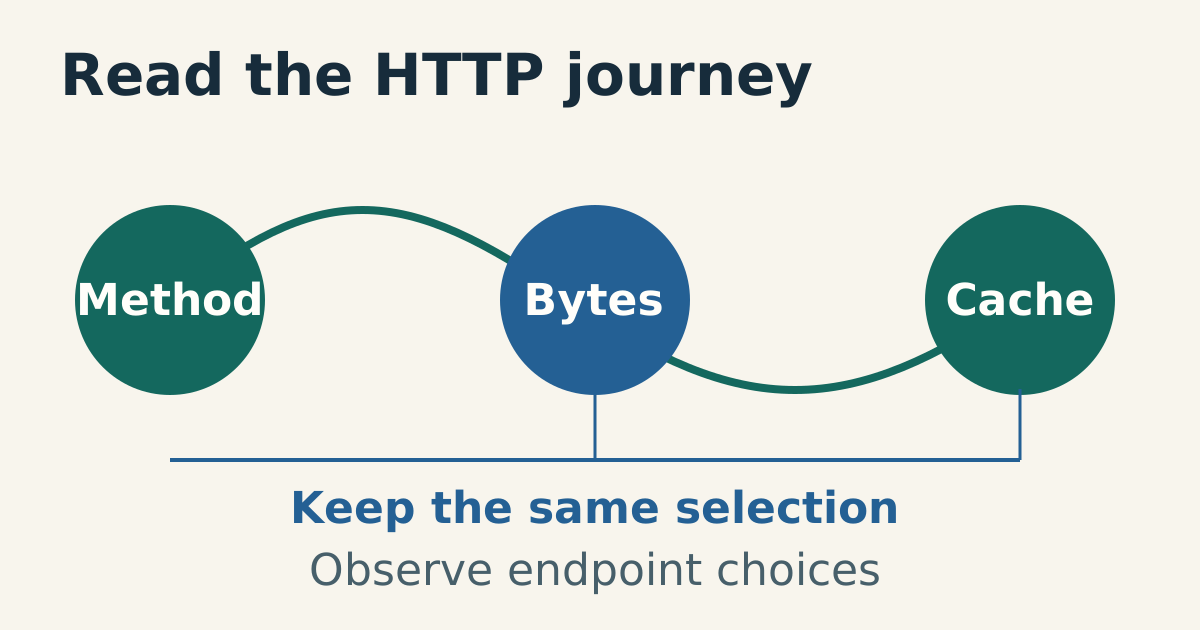
Method, selected bytes and cache form a client evidence journey; the same representation selection connects comparisons.

Read a live edge the way a client does

Walk a live origin from method to body to cache, and leave with checks you can reuse.

August 7, 2026 · 8 min · XB Field Notes
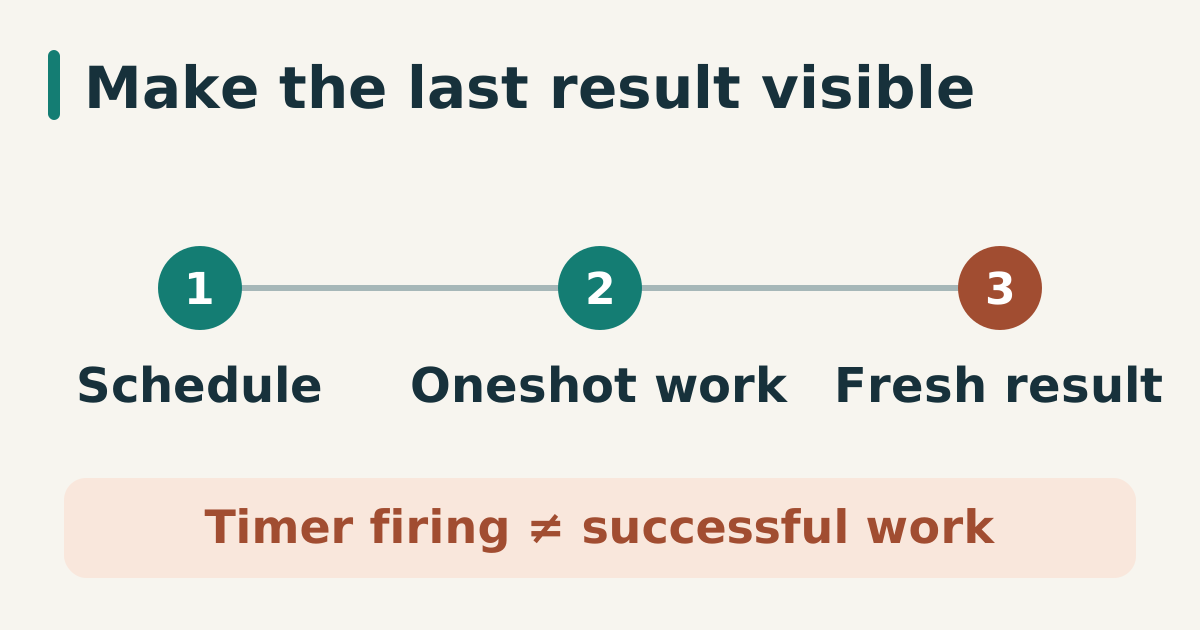
A timeline separates calendar scheduling, oneshot work and the fresh result. Timer firing alone does not establish success.

A maintenance timer should leave its last result visible

Scheduling is only half the job; operators also need to see when the task last ran and how it ended.

August 4, 2026 · 3 min · XB Field Notes