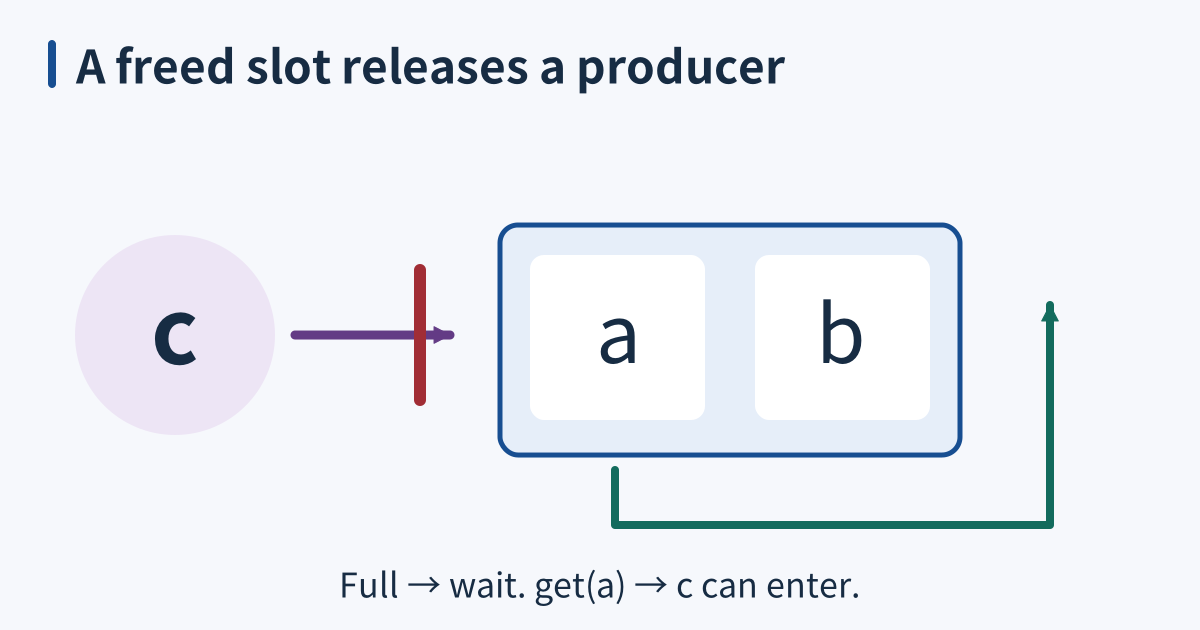
Producer c waits outside a full two-slot queue holding a and b. An outgoing path shows that get(a) frees a slot, permitting c to enter.

Backpressure works when bounded admission changes the producer’s behavior

Backpressure connects a consumer’s limited capacity to the behavior of its producers. A full channel may make a producer wait, reject new work, or apply a deliberately chosen shedding policy. The important property is that the limit changes what upstream components do. A growing queue or a dashboard showing lag is evidence of imbalance, but neither is automatically a mechanism that controls admission. ...
August 12, 2027 · 5 min · XB Field Notes
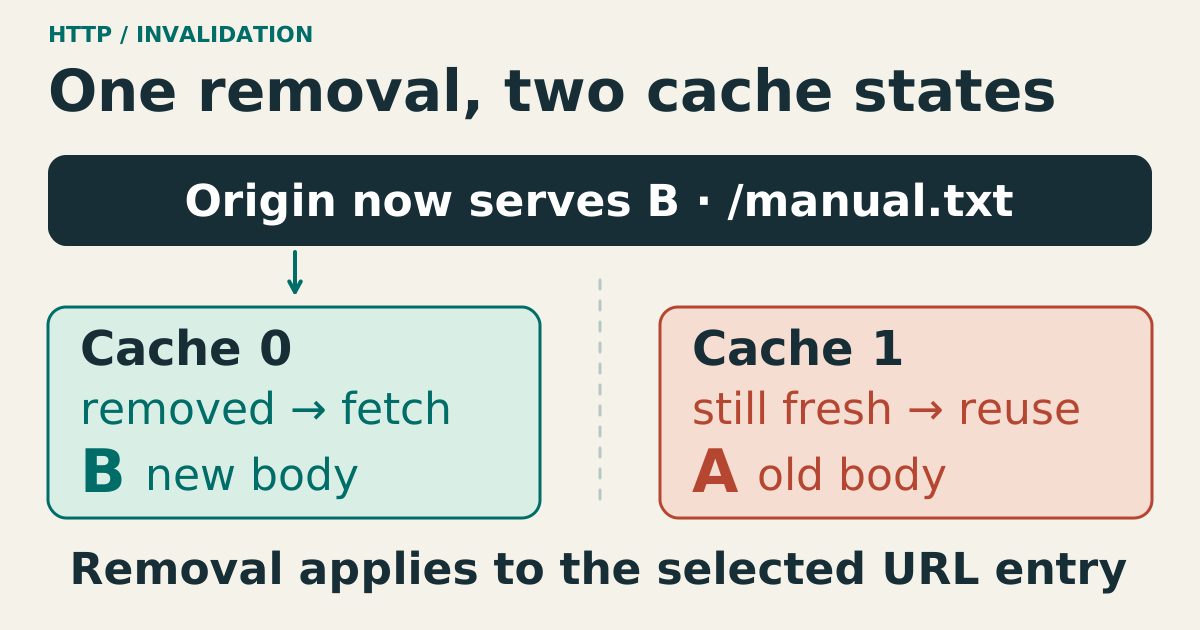
The origin now serves B at /manual.txt. Cache zero’s exact entry is removed, so its next request fetches B. Cache one is independent and still holds fresh A, which it reuses. One targeted removal does not synchronize both caches.

Cache invalidation is a push, not a prayer

Changing an origin does not notify every cache that already holds its response. Invalidation is about controlling which stored copies remain eligible for reuse, not merely updating a file. A reliable release distinguishes expiration, validation, targeted removal, and choosing a new URL. These mechanisms have different scopes, and none remotely erases every copy a reader has downloaded. ...

August 5, 2027 · 5 min · XB Field Notes
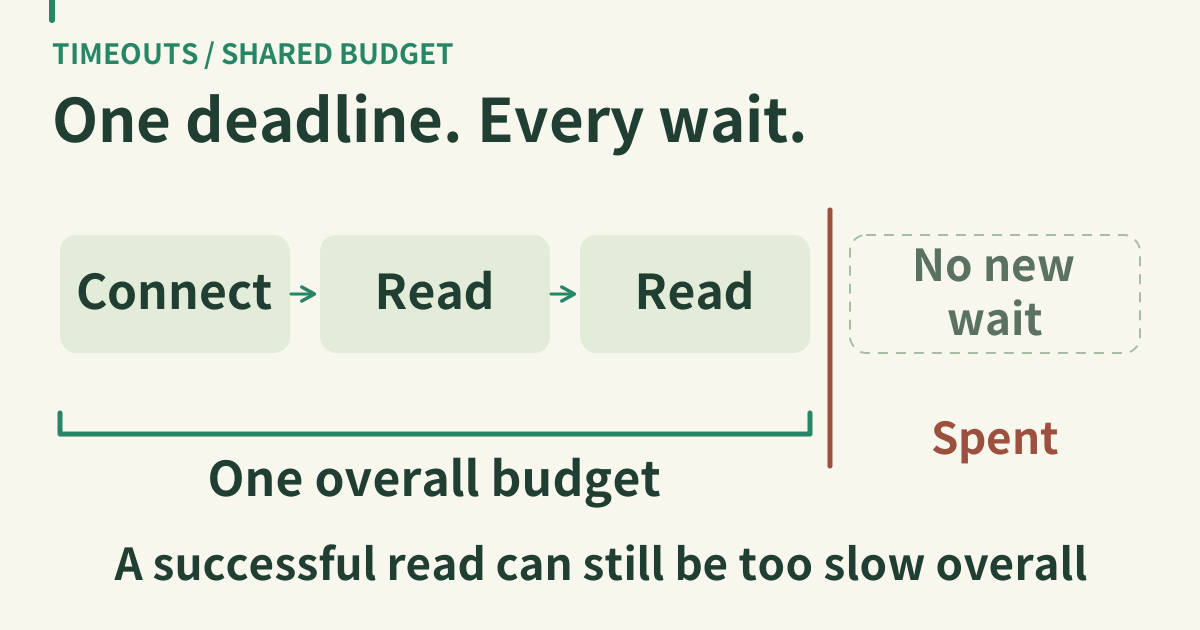
Connection and two reads share one overall budget. A further wait is not started after the budget is spent; a successful individual read does not ensure timely completion.

Connection timeouts prevent silent hangs

A timeout names how long a particular operation may wait. It is not automatically a deadline for the whole request, and it does not prove that the remote operation stopped. Separate connection establishment, individual reads, and the caller’s overall budget before choosing numbers or interpreting a timeout error. ...

August 1, 2027 · 5 min · XB Field Notes
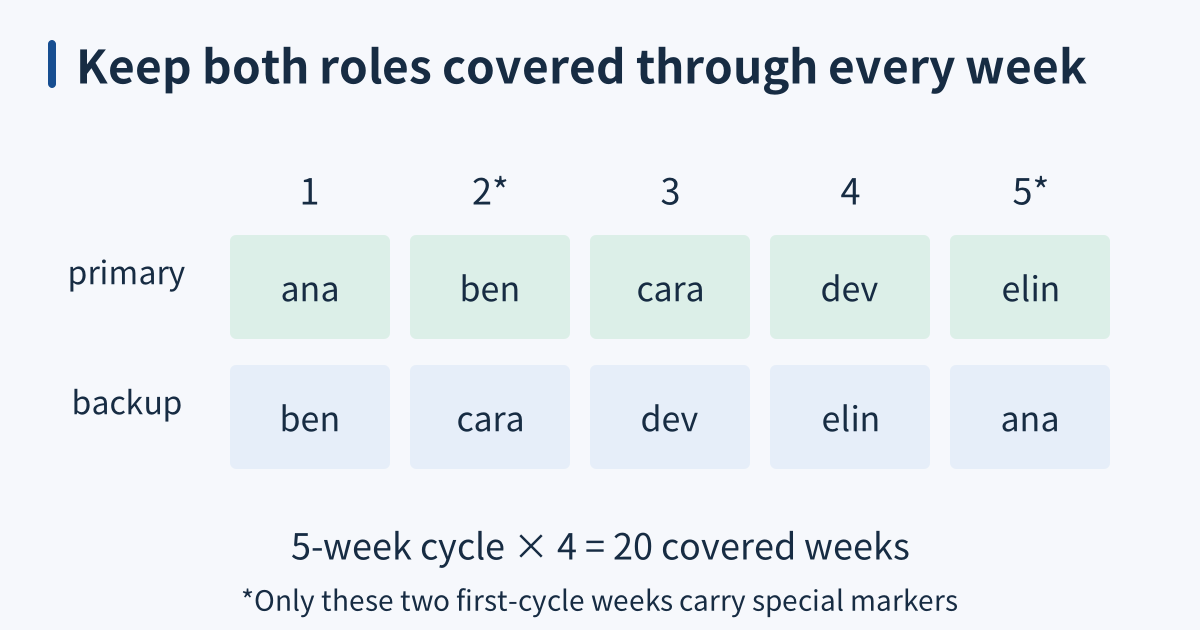
A five-column primary/backup rota cycles five fictional names with different roles each week. Four repetitions cover 20 weeks; only first-cycle weeks 2 and 5 have invented special markers.

A rota needs continuous coverage and a load review

A rota can distribute responsibility, but equal shift counts do not guarantee equal burden. Review nighttime pages, incident effort, recovery time, and reliable backup alongside the schedule. A job that is shared On-call work is a job that belongs to a team, not to one hero. A rotation turns ‘whoever was last awake’ into a defined roster and a schedule, so responsibility is explicit and no one is assumed to carry the whole queue indefinitely. The schedule itself — a weekly handoff, a backup/secondary on-call, a follow-the-sun structure across sites — is how you keep the obligation sustainable without letting it turn into a possession. Don’t let the urgency of tonight’s page decide who owns tomorrow; the rotation decides on purpose, ahead of time. ...

July 16, 2027 · 5 min · XB Field Notes
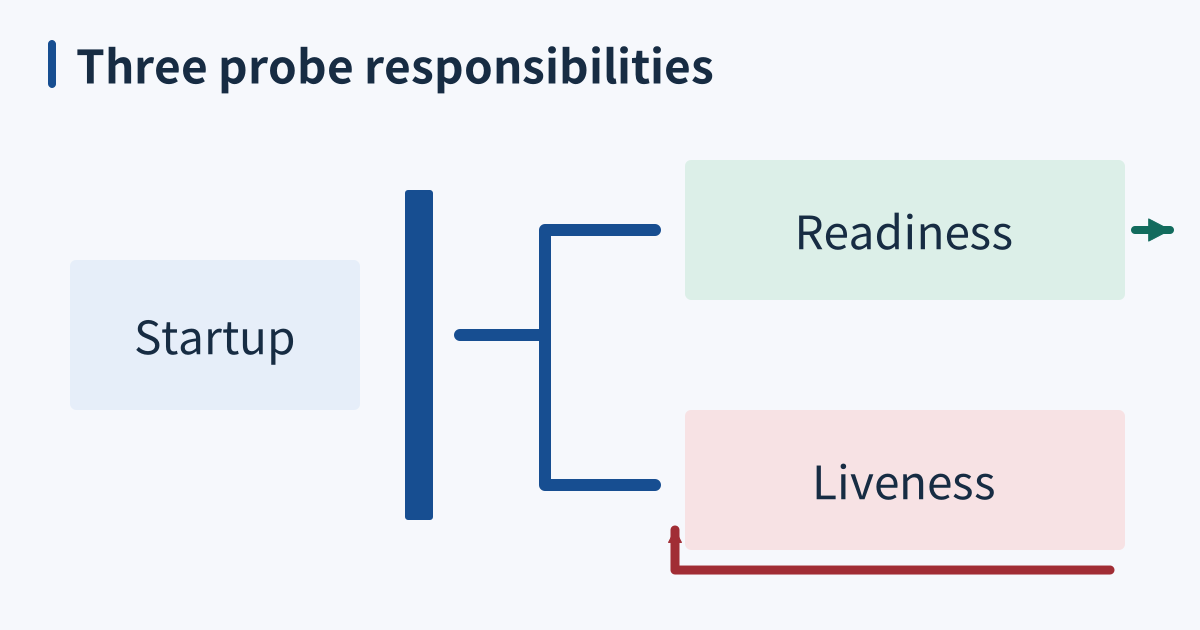
A startup latch gates readiness traffic eligibility and liveness restart handling as separate branches.

Probes tell the platform when to act

A probe result is evidence consumed by a control loop. Kubernetes does not infer your application’s recovery strategy from a route named healthz. The probe type, result, configured thresholds, and container lifecycle determine what happens next. Treating every failure as “restart the Pod” erases distinctions that directly affect availability. ...

June 18, 2027 · 6 min · XB Field Notes
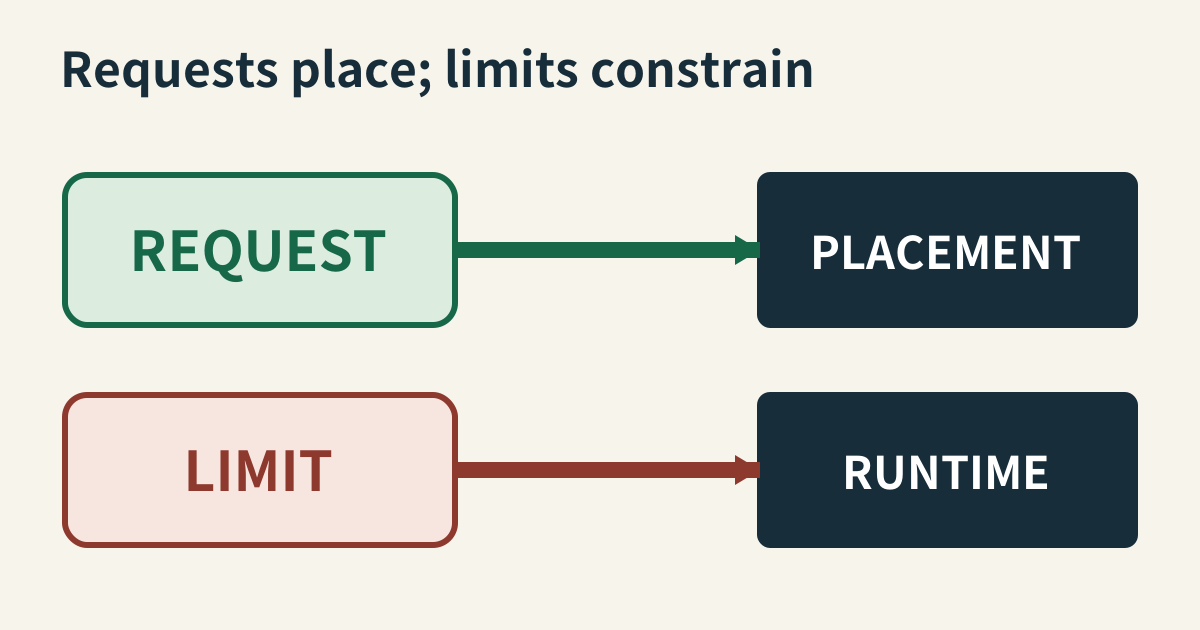
Separate arrows connect resource requests to placement and resource limits to runtime enforcement. Limits are not scheduler reservations.

Resource limits constrain execution; requests guide placement

A Kubernetes resource request and a resource limit belong to different decisions. Requests participate in scheduling and resource sharing; limits configure execution constraints supported by the runtime and operating system. Treating a limit as the scheduler’s reservation obscures both mechanisms. A useful resource policy identifies placement needs, acceptable contention and the failure behavior when a running workload reaches its boundary. ...

June 14, 2027 · 6 min · XB Field Notes
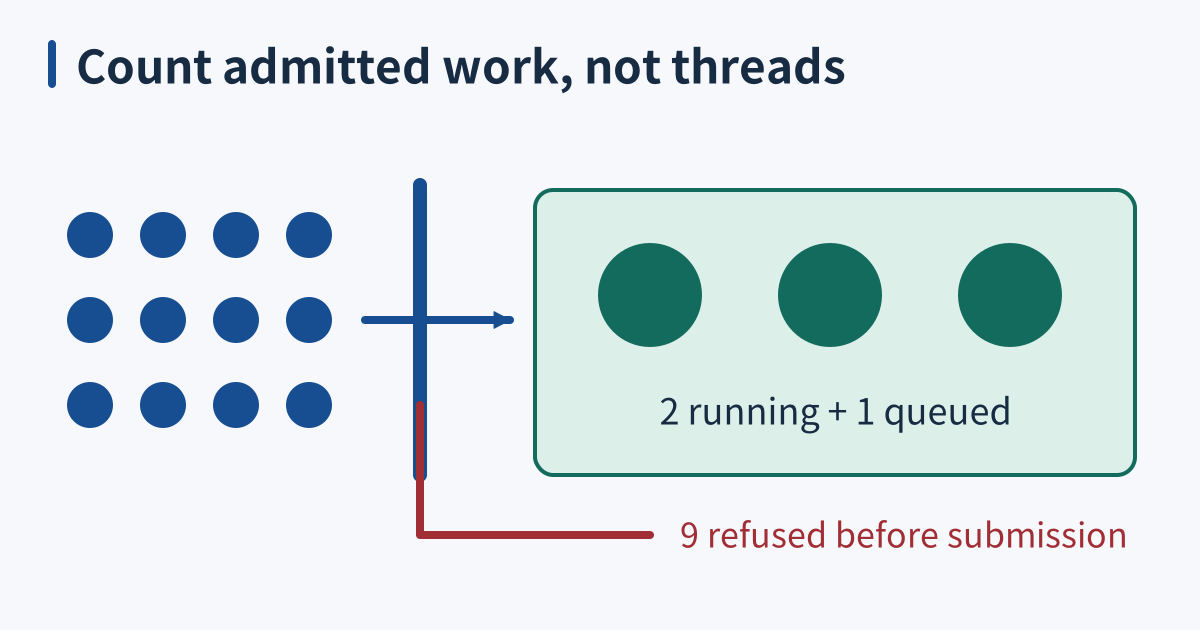
Twelve incoming tasks meet an admission gate. Three are accepted, comprising two running and one queued; nine are refused before executor submission.

Load shedding protects the system

Load shedding deliberately refuses some work when accepting everything would threaten useful service. The aim is to preserve capacity for work that can still complete, not to promise that every accepted request will be fast or important. Rejection is itself work, so the admission point and its cost matter as much as the threshold. ...

May 16, 2027 · 6 min · XB Field Notes
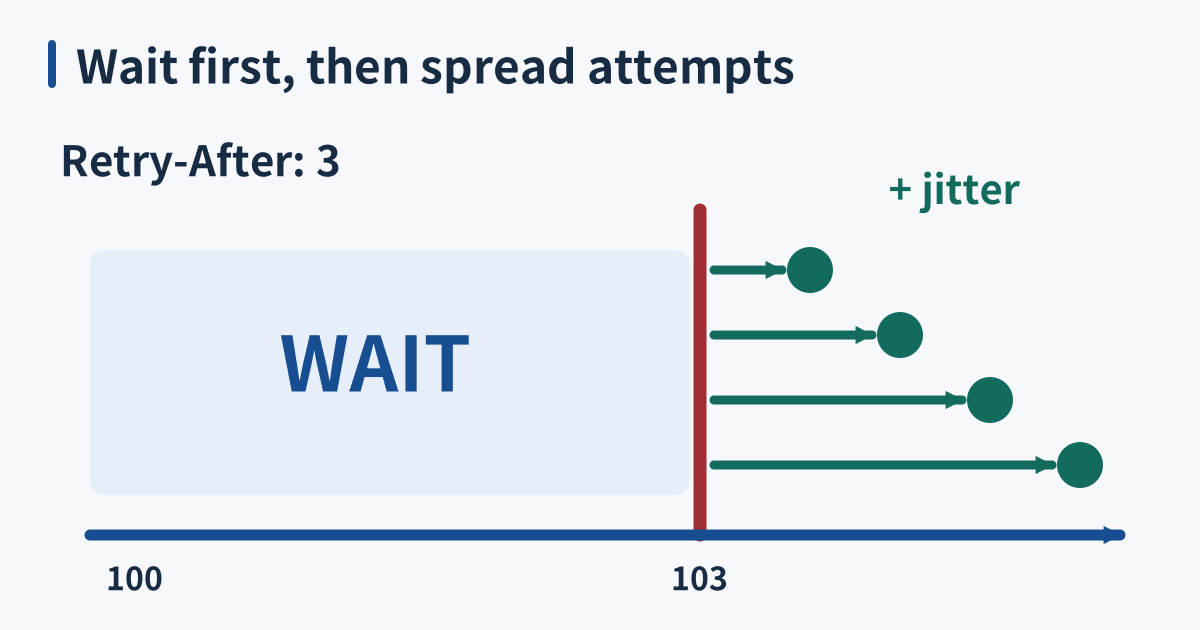
A received three-second wait creates an earliest retry boundary; nonnegative jitter places planned attempts after it. A deadline can stop the policy.

Retry-After tells when to try again

Retry-After tells a client how long it ought to wait before a follow-up request. It is a scheduling signal, not proof that the next attempt will succeed or that replaying the original operation is safe. A client still needs a deadline, an attempt policy, and a decision about which operations it can retry. ...

May 4, 2027 · 7 min · XB Field Notes