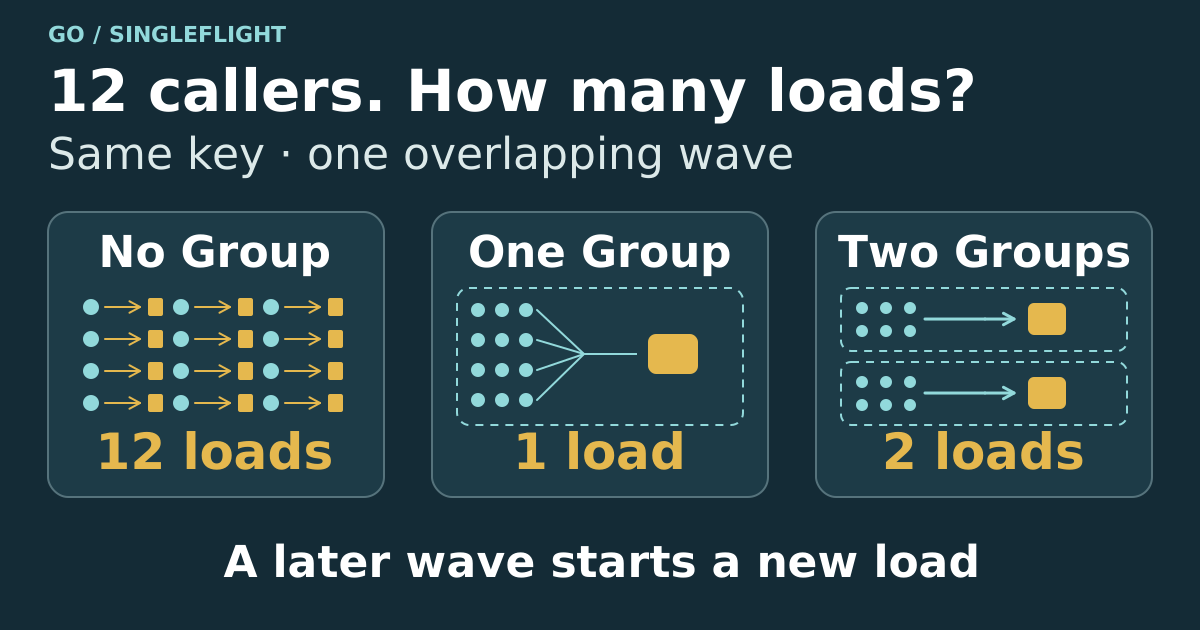
For twelve overlapping calls using the same key, the article’s controlled fixture makes twelve loader calls without coalescing, one within one shared Group, and two across two independent Groups. When a wave finishes, the next wave loads again.

A cache stampede hits when expiry syncs

A cache stampede occurs when concurrent misses cause redundant work against the same dependency. Synchronized expiration is one trigger, but eviction, a cold deployment, or cache unavailability can create the same burst. A single popular key can be enough. The useful question is how many rebuilds reach the source while one result is still being computed. ...
November 22, 2027 · 5 min · XB Field Notes
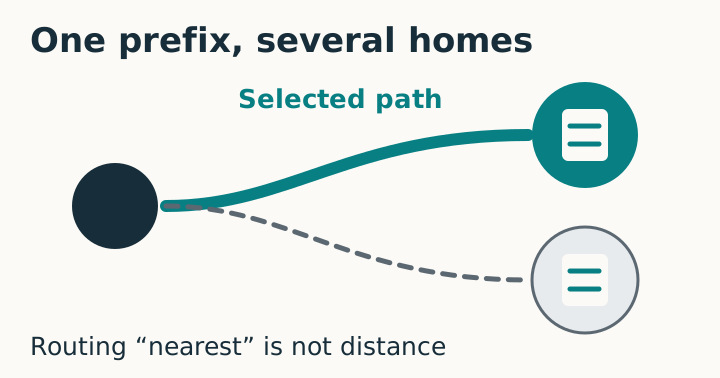
Several replicas advertise one prefix; the observing network chooses a usable path according to routing policy. Routing nearest is not a geographic-distance guarantee.

Anycast lets routing select a replica

Anycast gives an address several homes. Multiple sites announce the same prefix, and each network selects a usable path according to routing policy. This article focuses on Internet BGP; local anycast can use an interior routing protocol. A client usually lands at a topologically close replica without first contacting a global load balancer. When one site withdraws its announcement, the control plane can converge on another home. ...

November 1, 2027 · 5 min · XB Field Notes
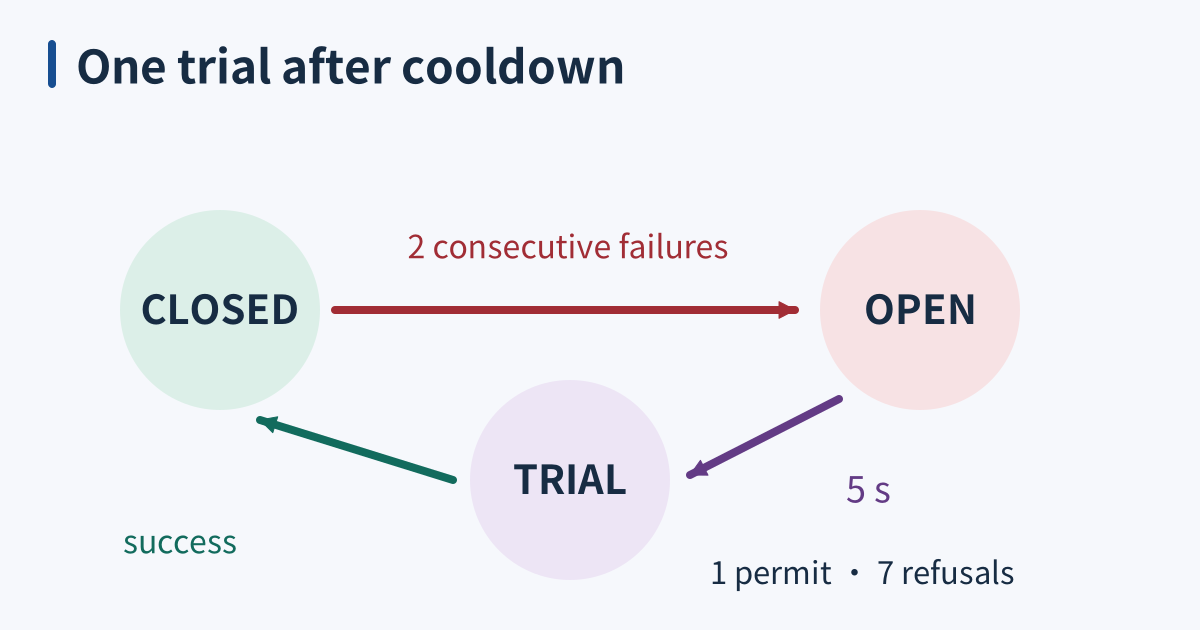
The local breaker model moves from closed to open after two consecutive failures, waits five seconds, then admits one trial. A successful trial returns to closed; the eight-candidate experiment gives one permit and seven refusals.

Circuit breakers stop storming a down service

A circuit breaker decides whether a new call should reach a dependency that appears unhealthy. It can reject promptly instead of spending resources on another likely failure. It does not repair that dependency, cancel calls already running, or prove that rejected work would have failed. Its value depends on the failure signals and recovery policy it actually implements. ...

April 6, 2027 · 6 min · XB Field Notes
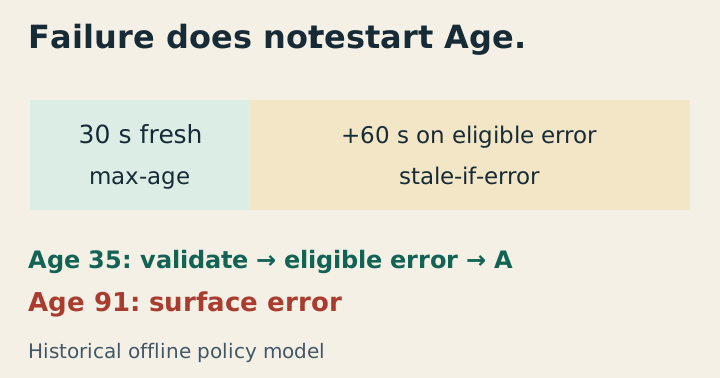
A proportional 30-second freshness segment is followed by 60 seconds of stale-if-error allowance. In the historical offline model, age 35 requires validation before an eligible error keeps A; age 91 surfaces the error. Failure does not restart Age.

Stale cache needs a bounded policy

A stale response can preserve access to a public manual during an origin outage. It can also preserve an obsolete price, revoked permission, or misleading status. Availability is not automatically more important than correctness. Choose the information that may remain usable, the conditions that permit reuse, and the maximum tolerable age before enabling this behavior. ...

February 1, 2027 · 6 min · XB Field Notes