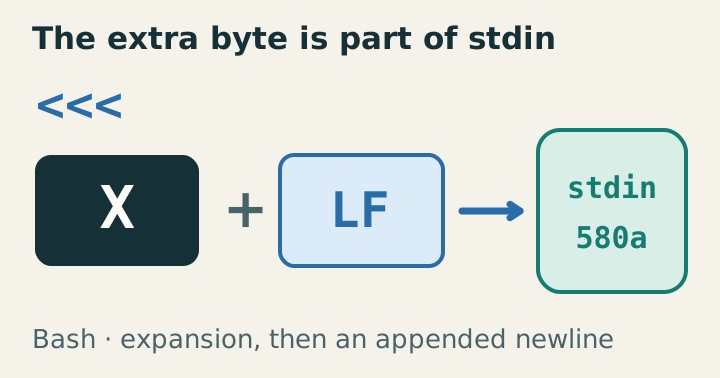
Expanded X plus one appended LF is supplied to stdin as the hexadecimal bytes 580a.

A here-string supplies text and a newline

A Bash here-string supplies the expanded value of one word to a command’s standard input, with a newline appended. It is convenient when a small textual value already exists in a variable and the receiving tool reads stdin. The syntax removes the need for a separate printing command, but it does not promise byte-for-byte identity with the variable or a particular implementation using memory, a pipe, or a file. ...
February 15, 2027 · 4 min · XB Field Notes
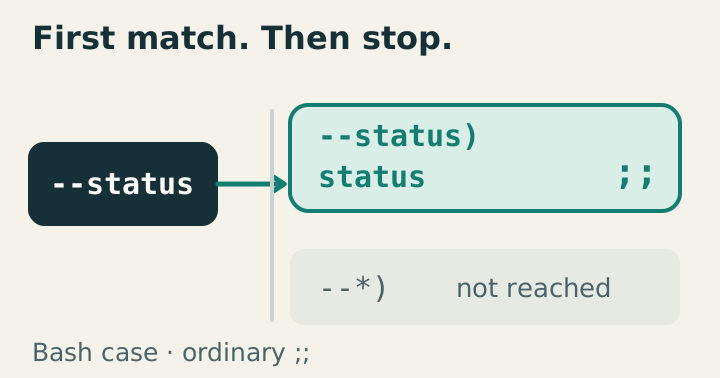
An input --status selects an earlier exact case branch and stops at ;; before the broader --* branch.

case runs one branch that matches a pattern

A case statement routes one value through an ordered list of shell patterns. It is useful for a command dispatcher, a small set of accepted answers, or filename-suffix classification. Each branch states the values it handles, and several patterns can share one body. The ordering and the default branch are part of the interface: they decide what happens when an input overlaps several categories or belongs to none. ...

January 30, 2027 · 5 min · XB Field Notes
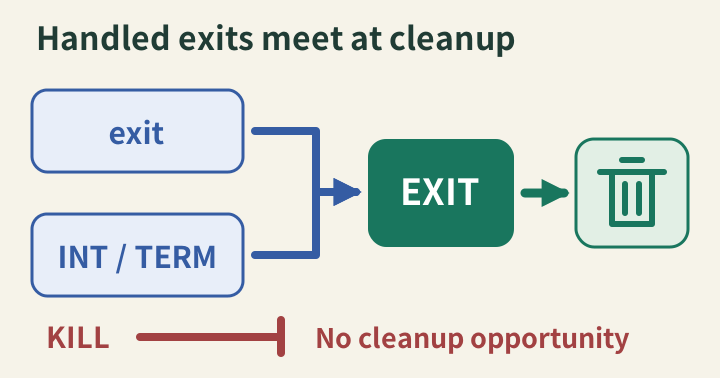
An explicit normal exit and INT or TERM handlers that explicitly exit converge on a shared EXIT cleanup step. A red KILL route ends at a stop bar before cleanup.

Shell traps turn a signal into a cleanup step

A trap lets a shell arrange an action for a signal or a shell event. It is useful for removing temporary files and coordinating shutdown, but it does not make interruption atomic or guarantee cleanup under every termination. In Bash, trap is a builtin, and EXIT is a shell event rather than an operating system signal. A reliable design names the exits it handles and preserves evidence of why execution stopped. ...

January 12, 2027 · 5 min · XB Field Notes