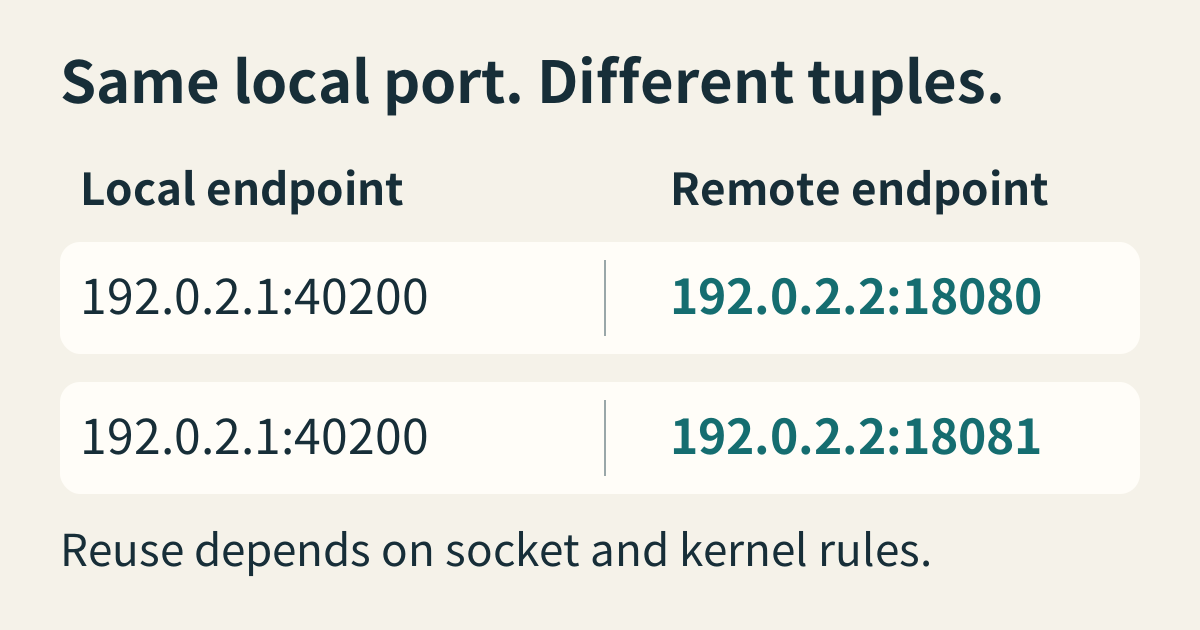
Two connection tuples share local address 192.0.2.1 and port 40200 but differ in the remote port, 18080 versus 18081. Reuse depends on socket and kernel rules.

TIME-WAIT protects a connection incarnation, not exclusive ownership of a port

TIME-WAIT is a TCP state retained after certain orderly connection closures. It gives the closing exchange time to complete if the final acknowledgment must be repeated and helps prevent delayed segments from an earlier connection incarnation being confused with a later one. The relevant identity includes both endpoint addresses and ports. A TIME-WAIT entry is not simply a universal lock on one local port number. ...
November 13, 2026 · 6 min · XB Field Notes
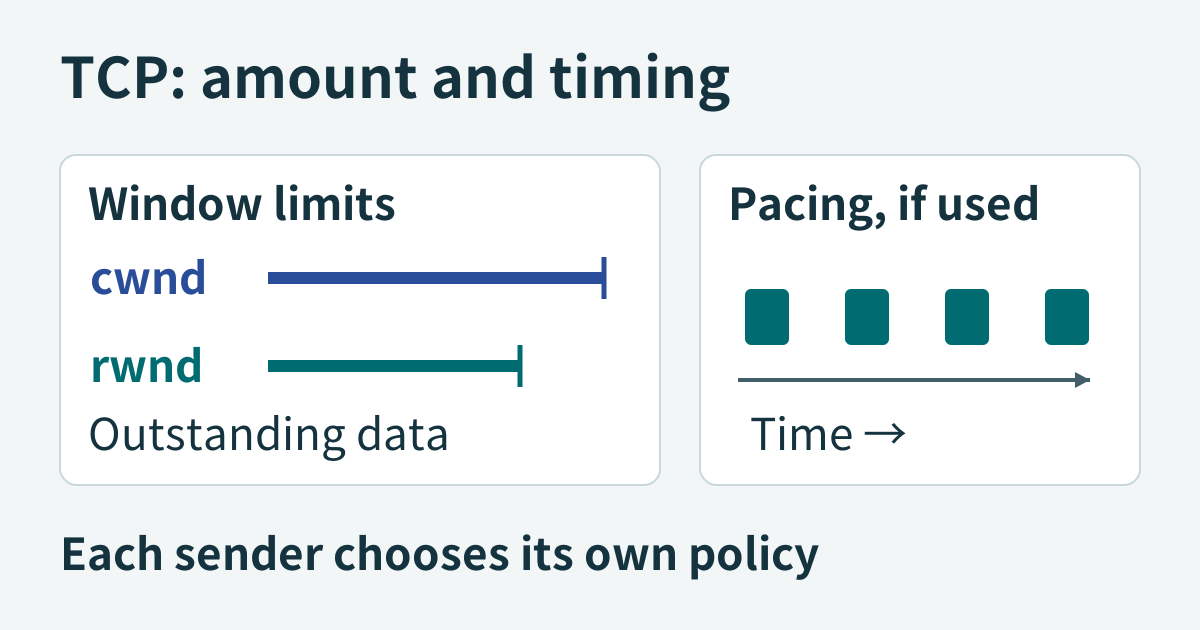
Two separate window limits constrain outstanding data; a separate pacing timeline spaces transmissions. Each sender chooses its own congestion policy.

TCP congestion control belongs to each sender, and peers can use different algorithms

TCP congestion control limits how a sender injects data into a network that has finite shared capacity. Its congestion window constrains outstanding data, while pacing, when used, controls how transmissions are distributed over time. The receiver’s advertised window imposes a separate flow-control limit. These mechanisms interact, but they describe different constraints and should not be collapsed into one ambiguous sending-speed setting. ...

November 12, 2026 · 6 min · XB Field Notes