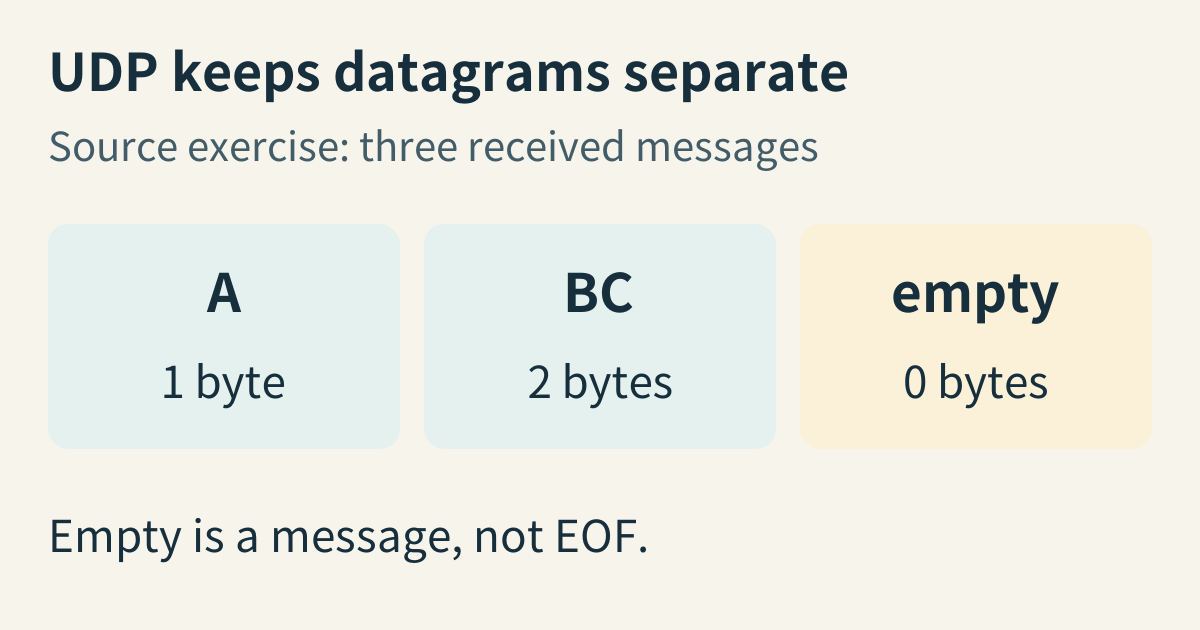
Three separate datagram cards show A with 1 byte, BC with 2 bytes, and empty with 0 bytes. The empty payload remains a message and is not EOF.

UDP preserves datagrams; recovery and timing belong to the application

UDP carries discrete datagrams between transport endpoints. Its eight-byte header contains source port, destination port, length, and checksum fields. The protocol does not add TCP’s reliable ordered byte stream or its congestion-control behavior. This gives applications room to choose their own delivery policy, but it does not promise lower latency for every workload. A missing datagram can be more costly than a handshake when the application needs its contents. ...
November 11, 2026 · 5 min · XB Field Notes
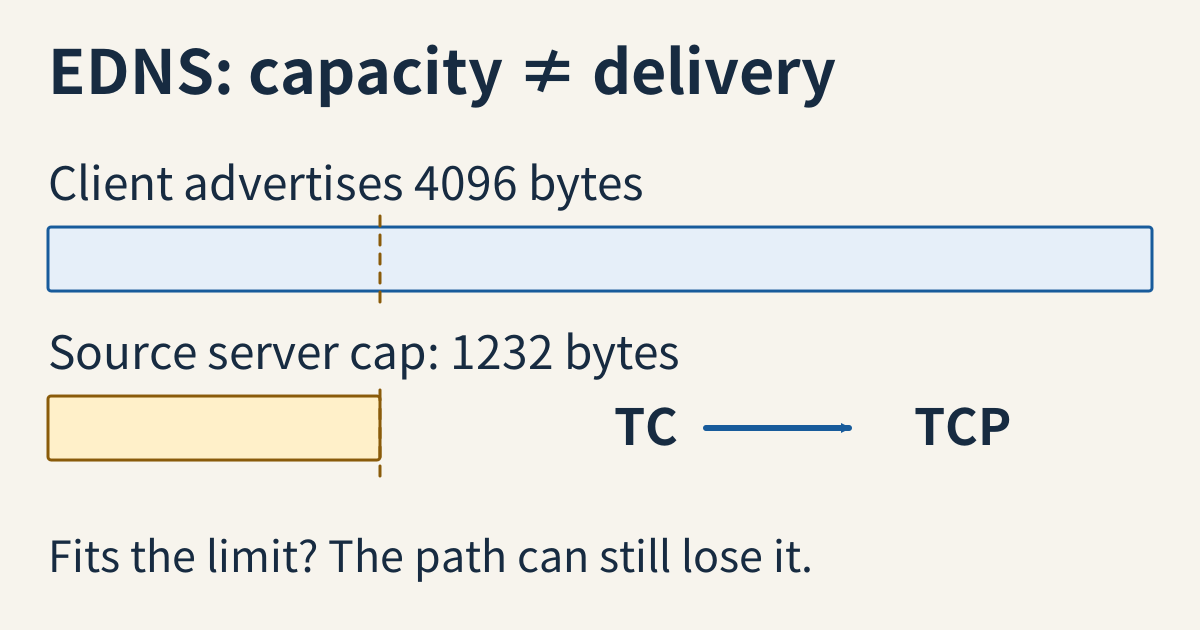
A client advertises 4096 bytes but the source server caps UDP at 1232. A truncated answer can require TCP; the path still determines delivery.

EDNS advertises UDP capacity without guaranteeing path delivery

EDNS extends DNS through an OPT pseudo-record. Among other information, a request can advertise the UDP payload size its sender is prepared to receive. This allows answers beyond the traditional 512-byte DNS limit. It is an advertisement within a DNS exchange, not a network path-MTU discovery protocol or a promise that every intervening device will deliver a datagram of that size. ...

October 28, 2026 · 6 min · XB Field Notes